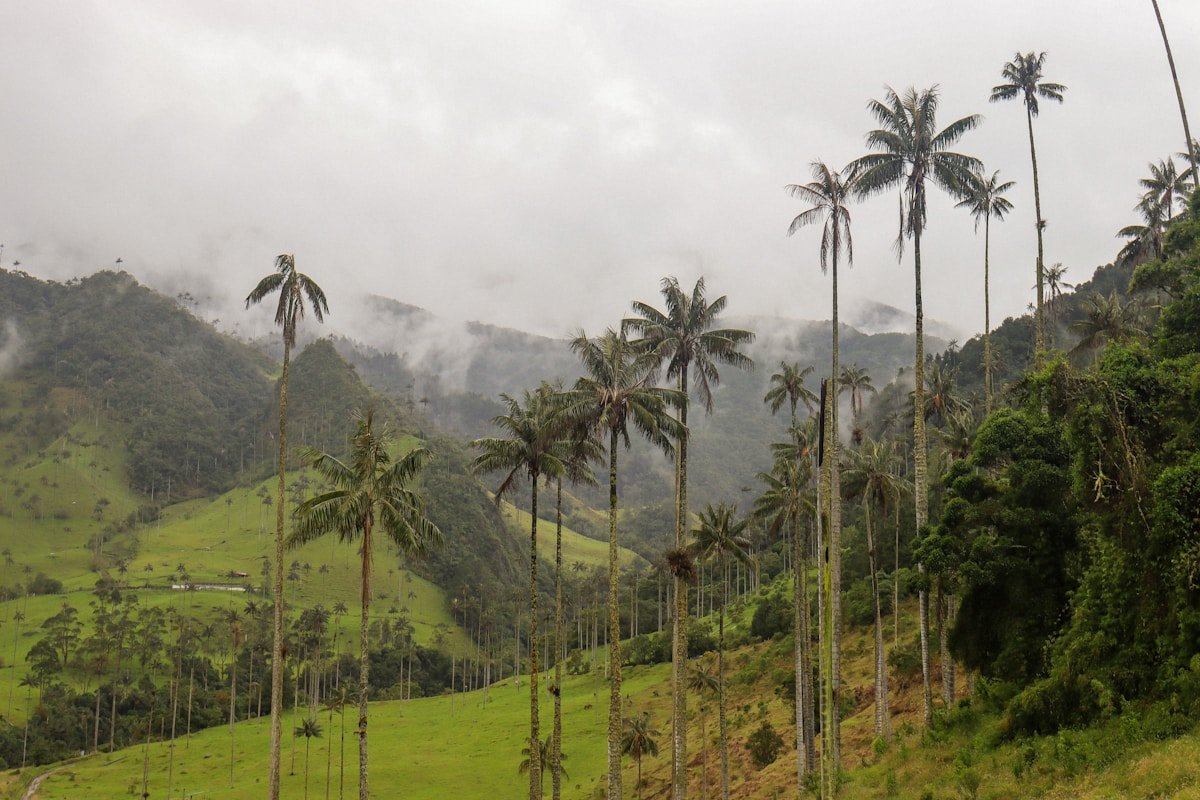
Cocora Valley sits 45 minutes by shared jeep from Salento, in the heart of Colombia’s Coffee Region. It holds the most iconic landscape in all of the Eje Cafetero: open green pastures dotted with wax palms that rise 40 to 60 metres into the sky, many with their crowns disappearing into low cloud. The wax palm (Ceroxylon quindiuense) is Colombia’s national tree, and Cocora is where it grows tallest.
The full hike combines the open palm meadow with a loop through cloud forest and a visit to the Acaime hummingbird sanctuary. Done properly, it takes half a day and covers around 12 kilometres.
Getting to Cocora Valley from Salento
From Salento’s main plaza, shared Willys jeeps depart for Cocora Valley from approximately 6:30–7:30am. Jeeps run roughly every 30–45 minutes when full. The journey takes 15–20 minutes on a steep unpaved road. The fare is approximately COP 5,000 to COP 7,000 each way as of 2026.
Return jeeps run from the valley throughout the afternoon, with the last usually leaving around 5:00–5:30pm. Get there early if you want a guaranteed spot going back without a long wait.
Tip: Taking the first or second jeep (6:30–7:30am) gets you into the cloud forest before afternoon cloud and rain move in, and gives you the open palm valley in the best morning light.
Arriving by taxi from Salento costs approximately COP 25,000 to COP 35,000 each way. If you’re a small group, this can work out cheaper and faster than waiting for a full jeep.
Trail Overview and Route Options
The Full Loop (Recommended)
The classic route is a loop of approximately 12 kilometres that passes through three distinct environments: the open palm meadow, dense cloud forest, and the Acaime sanctuary area.
Direction: Walk anti-clockwise (take the right fork immediately after the trailhead bridge). This means entering the cloud forest first and descending into the open palm valley at the end - the recommended order. The cloud forest ascent is easier to navigate going uphill (the trail can be confusing on descent), and arriving at the palm valley after the forest creates a dramatic visual contrast. Going clockwise (left fork) is possible but trail-finding is harder and you reach the best scenery before your legs are warmed up.
The route:
- From the trailhead, cross the wooden bridge and take the right fork through open farmland
- After about 2 kilometres, the trail climbs into cloud forest on a steep switchback path with rope sections on the steepest pitches
- The path levels out and passes through a section of bamboo and fern
- You reach the Acaime hummingbird sanctuary after roughly two hours from the start
- From Acaime, descend back through the forest and return via a different path through more palm meadow
Acaime admission: approximately COP 5,000 to COP 8,000 as of 2026, which covers a small hot chocolate and cheese on arrival.
Short Out-and-Back (2 hours)
If you’re short on time or not up for the full loop climb, the path from the trailhead through the main palm meadow and back is beautiful in its own right. The most dramatic palm concentration is within 2 to 3 kilometres of the entrance.
Difficulty and Fitness
The full loop rates moderate. The cloud forest section climbs roughly 300 metres in elevation over 3 to 4 kilometres on uneven, often muddy trails. After rain, the descent from Acaime can be slippery. The open meadow sections are flat and easy.
People in reasonable fitness with some walking experience handle the full loop without issue. Take it slowly on the forest climbs and rest at Acaime. The trail is not suitable for flip flops or flat-soled shoes.
What to Bring
Essential:
- Waterproof hiking boots or trail shoes with grip (rubber boots for rent at the trailhead for approximately COP 8,000–12,000 if you don’t have them)
- Rain jacket or poncho (cloud forest sections will be wet even in dry season)
- Enough water for 4 to 5 hours (at least 1.5–2 litres per person)
- Snacks or packed lunch (the only refreshments on trail are at Acaime)
- Sunscreen and insect repellent
Optional but useful:
- Trekking poles (useful on the steep, muddy descent from Acaime)
- Binoculars (hummingbirds at Acaime and condors occasionally soaring above the palms)
- Layers - the cloud forest runs 15–18°C, noticeably cooler than the open palm valley (20–22°C)
Guided Options and Tour Operators
Several operators in Salento offer guided Cocora Valley hikes. A local guide makes a meaningful difference if you want to understand the ecology, palm life cycle, and history of the valley.
Recommended operators (as of 2026):
- Cocora Guide Association (Asociacion de Guias Cocora): Based at the trailhead. Walk-in rates approximately COP 50,000 to COP 80,000 per person depending on group size
- Tours from Salento: Several hostels and agencies in Salento arrange guided half-day trips including jeep transport. Prices from approximately COP 90,000 to COP 140,000 per person as of 2026. Ask at your accommodation or check with tours in Salento
Search hotels in Salento on Booking.com
Private guides can also be arranged through the Cocora Guide Association office at the trailhead car park.
Horses
At the trailhead, you’ll be offered horses for the first section of the trail. This is a local tradition rather than a trekking necessity. Horses cover the palm meadow section but do not continue into the cloud forest or to Acaime. If you want to do the full hike on foot, politely decline. Horse hire runs approximately COP 25,000 to COP 40,000 per person as of 2026.
Best Time to Visit
Cocora Valley can be visited year-round. The driest months are December to February and June to August. During these periods, trails dry out between rain events and cloud forest views are more likely to clear in the mornings.
The wettest months (April and October) make the forest ascent genuinely muddy and increase the risk of slipping on the descent from Acaime. That said, the valley is never fully dry - you will likely encounter cloud and some mud regardless of season.
Crowd levels: Weekdays are noticeably quieter than weekends. If you visit on a Saturday or Sunday during peak season (December to January or June to July), expect busy trails and a wait for return jeeps.
Trailhead Facilities
At the Cocora Valley car park, you’ll find:
- Several restaurants serving trout (trucha - fresh river trout is the local speciality), bandeja paisa, and hot drinks. A full set lunch runs approximately COP 20,000–35,000.
- Toilet facilities (small charge, COP 1,000–2,000)
- The Cocora Guide Association office
- Horse rental operators
- Rubber boot and poncho rental
- Souvenir stalls
The restaurants are a natural post-hike stop before the jeep back to Salento. There are no facilities on the trail itself beyond Acaime.
Combining Cocora with a Coffee Farm
Many visitors combine the morning Cocora hike with an afternoon coffee farm tour. Several fincas near Salento offer afternoon sessions starting around 2pm or 3pm. After returning from the valley by 1pm, you have time to freshen up, eat in Salento, and reach a nearby farm for the afternoon tour. See our coffee farm tours guide for named fincas and booking details.
The Cocora Valley hike is the standout experience of the Coffee Region. The wax palms alone make it worth the trip from Bogota or Medellin. Allow a full morning, start early, and bring the right footwear. The cloud forest section is what separates the full loop from a simple meadow walk - don’t skip it.