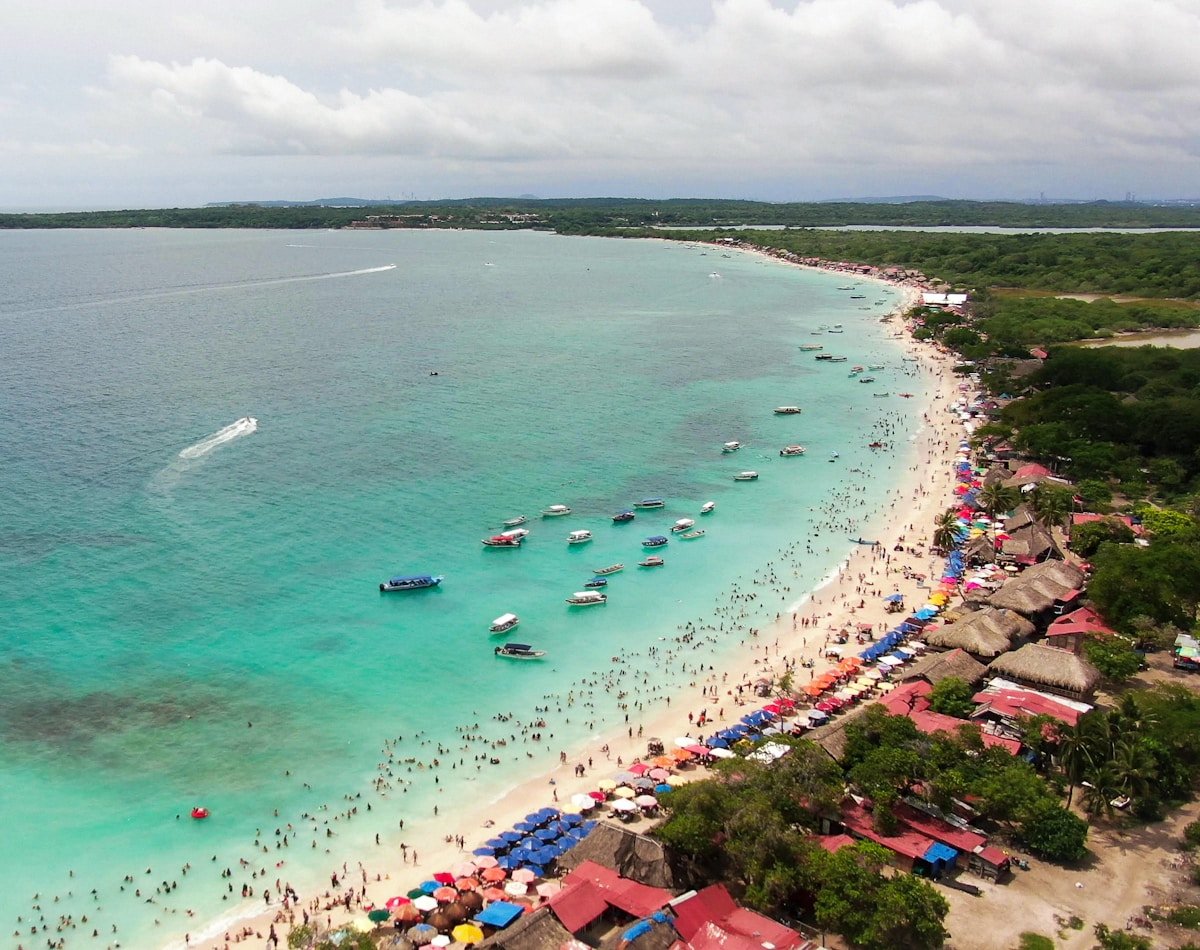
Cartagena sits at the edge of the Caribbean and the range of day trips available from the city is one of its major advantages as a base. Within 30 minutes by boat you reach some of the clearest water in Colombia. Within 2 hours by road you reach an Afro-Colombian village that kept the Palenquero language alive since 1691 and a mud volcano that has been erupting for centuries. Here is how to plan each trip.
Islas del Rosario (Rosario Islands)
Distance: 45 km southwest by boat | Journey time: 1.5 to 2 hours each way | Best for: Snorkelling, swimming, clear water
The Islas del Rosario is an archipelago of 27 small islands and coral cays 45 kilometres from Cartagena across Cartagena Bay and the inner Caribbean. The water clarity is exceptional - visibility commonly reaches 15 to 20 metres - and the coral reef ecosystem supports manta rays, sea turtles, moray eels, and a high density of reef fish.
The main visitor attractions are the snorkelling sites around the outer islands and day beach access at several private beach clubs. Corales del Rosario y de San Bernardo National Park covers the archipelago and entry to the park costs approximately COP 15,000 per person (collected on the boat or at the dock).
Standard day trip format: Most boats depart from Muelle de los Pegasos (near the Clock Tower in Cartagena) between 8am and 9am, stopping at a snorkelling site, then a lunch beach on one of the islands, before returning to Cartagena by 4pm. Group day trips cost approximately COP 55,000 to 80,000 per person for the boat ticket, not including national park entry, snorkelling equipment hire (COP 20,000 to 30,000), or lunch.
Private charters: A private boat for a group of 4 to 8 people costs approximately COP 450,000 to 700,000 for a full day, including the captain’s fee. Worth considering for groups as it allows flexibility on timing and stops.
Choosing an island: Isla Grande is the largest and most developed - it has beachfront accommodation and a small freshwater lagoon (Laguna Encantada). Isla Pirata is a smaller, less-visited island with good snorkelling on its eastern reef. Isla Tesoro has a well-maintained beach club (Punta Faro Resort - day access approximately COP 80,000 per person including lunch). Book Punta Faro or equivalent private beach clubs in advance during high season (December to January, July to August).
Playa Blanca, Isla Barú
Distance: 20 km south | Journey time: 30 to 45 minutes by boat, 1 hour by road | Best for: Beach day, casual Caribbean atmosphere
Playa Blanca on the mainland peninsula of Barú is the most accessible good beach from Cartagena and one of the most visited. The 2-kilometre strip of white sand and turquoise water sits below a fringe of palms and is backed by a continuous line of thatched restaurants and hammock-rental operators.
The beach is genuinely beautiful and the atmosphere is relaxed and local - this is where many cartageneros come on weekends. It is also very busy and quite commercial: expect persistent vendors selling food, drinks, massages, jewellery, and boat trips from the moment you arrive.
Getting there by boat: Boats depart from Muelle de los Pegasos from around 8am for Playa Blanca. Return boats run from the beach from 3pm to 5pm. Round trip approximately COP 25,000 to 40,000 per person.
Getting there by road: A taxi or private car via the Puente del Diamante bridge to Barú takes approximately 1 hour and costs COP 80,000 to 120,000 one way for the whole vehicle. Gives more flexibility on departure time than the fixed boat schedule.
Beach costs: Sunbeds and umbrellas from approximately COP 15,000 to 25,000 per person. Lunch (fish, rice, patacones) from approximately COP 28,000 to 45,000 at the beachfront restaurants. Hammocks slung between palms available for approximately COP 10,000.
Tip: Arrive early (first boat) to claim a spot and avoid the worst of the midday heat. Water quality and crowd levels are both better on weekdays.
Volcán del Totumo
Distance: 50 km northeast | Journey time: 1 hour each way | Best for: Mud bathing, unusual experience
The Volcán del Totumo is a 15-metre cone of earth that emits warm mud from a vent at its summit. The local legend that the Bishop of Cartagena blessed the volcano to turn its lava into mud in the 17th century is almost certainly not geological fact, but the experience of climbing into a pool of body-temperature mud surrounded by other tourists doing the same thing is distinctive regardless of its origins.
The mud is reported to have therapeutic properties (minerals, temperature, natural exfoliation) and there is a reasonable spa science argument for the skin benefits. Mainly it is very good fun and sufficiently bizarre that most visitors find the trip worthwhile.
Entry costs approximately COP 10,000 as of 2026. Mud rinse-off by local women in the lagoon below the volcano is tipped separately (approximately COP 5,000 to 10,000). Clothes-rinsing service at the lagoon is COP 5,000. The whole process - climbing in, floating in the mud for 20 minutes, rinsing off - takes about 1.5 hours.
Getting there: Day trip operators in Cartagena run Totumo excursions (typically combined with a lagoon visit) for approximately COP 45,000 to 65,000 per person including transport. Individual taxi/remise approximately COP 80,000 to 120,000 return for up to 4 passengers.
San Basilio de Palenque
Distance: 65 km southeast | Journey time: 1 to 1.5 hours each way | Best for: Afro-Colombian culture, history, language
San Basilio de Palenque was the first free African town in the Americas, established in 1691 after a group of escaped enslaved people led by Benkos Biohó formed an independent settlement in the forest beyond Spanish reach. The Spanish Crown eventually recognised the town’s freedom in a peace treaty. The community has maintained a distinct Afro-Colombian culture including Palenquero, a Spanish-African creole language still spoken by the town’s 4,000 residents as their first language - the only surviving such language in the Americas.
The UNESCO Intangible Cultural Heritage designation applies to both the cultural space of Palenque and the Palenquero language and oral traditions. A visit requires genuine respect for what the place represents - this is a living community, not a museum.
Getting there: Colectivos (shared minibuses) to San Basilio depart from the main bus station in Cartagena and from Barranquilla highway junctions for approximately COP 15,000 to 20,000 each way, journey time 1 to 1.5 hours. Alternatively, community-based tourism operators in Cartagena arrange guided visits for approximately COP 80,000 to 120,000 per person including transport and a local guide from the community.
Visiting: A community guide is strongly recommended - both for context and to ensure your visit benefits the community directly. Look for operators affiliated with the Palenque de San Basilio Cultural Foundation.
Mompox (Mompós)
Distance: 250 km southeast | Journey time: 4 to 4.5 hours each way | Best for: UNESCO heritage town, colonial architecture, Semana Santa
Mompox sits in the middle of the Magdalena River on an island formed by river branches and has been largely bypassed by modern development - the result is one of the most intact colonial towns in Colombia. Gabriel García Márquez used the town as inspiration for Macondo in One Hundred Years of Solitude and the riverside streets he would have walked remain recognisable in the novel.
The town is known for its filigree gold and silver jewellery work (a colonial craft tradition), its riverfront walk at sunset (Calle de la Albarrada), and its Semana Santa (Holy Week) processions - considered among the most elaborate and solemn in Colombia.
Mompox is genuinely better as an overnight trip. The 4.5-hour journey each way makes a pure day trip exhausting and leaves little time on the ground. If you go as a day trip, depart Cartagena by 5am. Hotel Villa de Mompox (from approximately COP 220,000 per room, on the riverfront) is the best base for a longer stay.
Search hotels in Cartagena on Booking.com
Getting there: Direct buses from Terminal de Transporte Cartagena to Mompox take 4 to 5 hours and cost approximately COP 60,000 to 80,000. Alternatively, boat from Magangué (reached by bus from Cartagena, 3 hours) to Mompox (45 minutes). The combined journey is comparable in time but the river leg is more atmospheric.
Practical Notes
Booking islands in advance: The Rosario Islands and Playa Blanca trips are easily arranged on the day at Muelle de los Pegasos - no advance booking needed except for private beach clubs during peak season.
Sunscreen: Pack high-factor mineral sunscreen for any beach or island day - the Caribbean sun is considerably stronger than what most European and North American visitors are accustomed to.
Water taxis vs. tour boats: For the Rosario Islands, a scheduled tour boat (colectivo) is sufficient for snorkelling stops and beach time. The selling point of private charters is flexibility on timing and the ability to reach less-visited islands.
Combining trips: Playa Blanca and Volcán del Totumo can be done in a single day (the volcano is on the coastal road between Cartagena and Barranquilla; Barú is the other direction). Both in one day is long. Most visitors prefer one destination per day.
Most of these trips are bookable as organised day tours with hotel pick-up, guide, and transport included: day trips and tours from Cartagena covers Rosario Islands, Totumo, Playa Blanca, and Palenque excursions. For a detailed breakdown of Rosario Islands tour options including catamaran vs. speedboat, what’s included, and what to bring: Rosario Islands day trip from Cartagena.
More on Cartagena: things to do in Cartagena, getting around Cartagena and Cartagena travel guide.