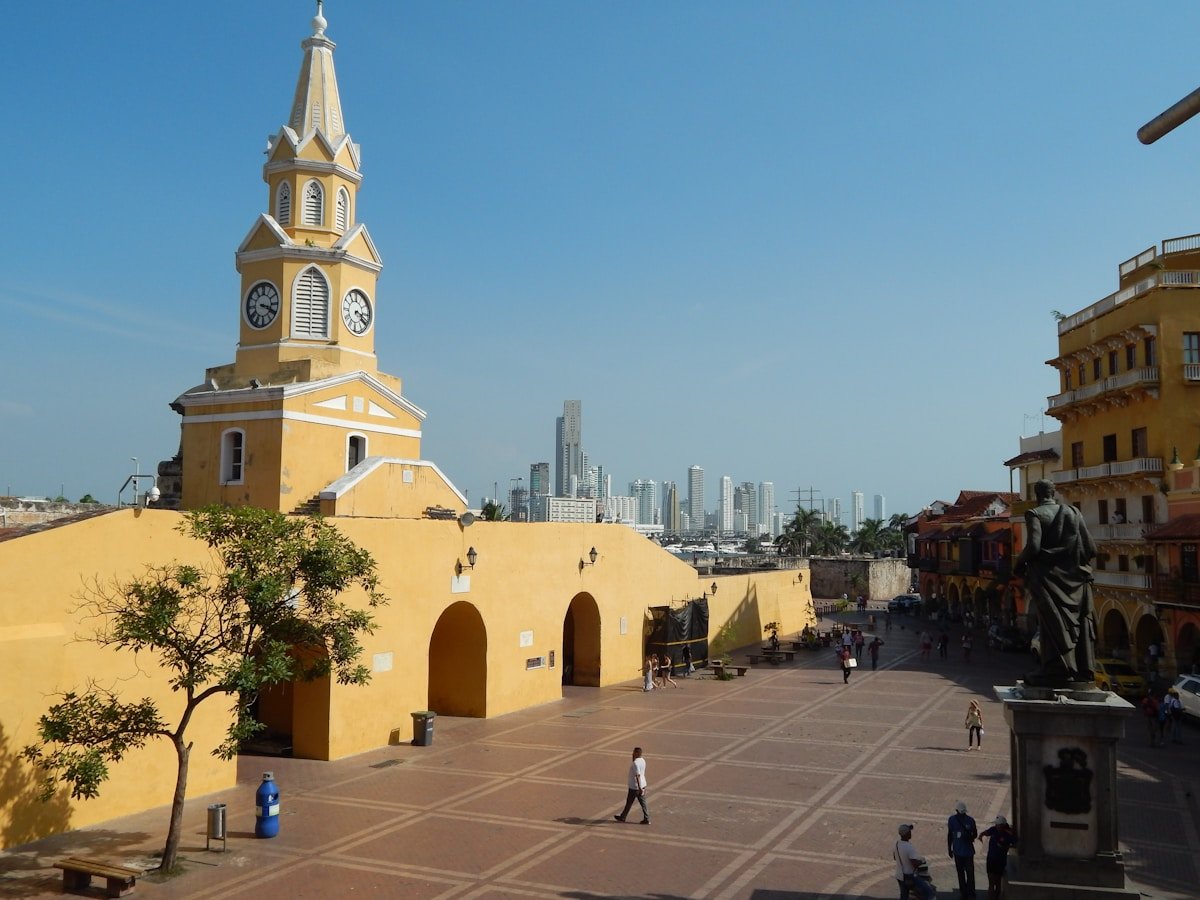
Cartagena is the most visually distinctive city in Colombia. The 13-kilometre city wall enclosing the historic centre is a UNESCO World Heritage Site, the colonial architecture inside is among the best-preserved in the Americas, and the Caribbean light and heat give the whole place a quality unlike anywhere else in the country. But Cartagena rewards careful planning - it is also heavily visited and some of the more touristy experiences can be expensive relative to the rest of Colombia.
The Walled City (Centro Histórico)
The walls - Las Murallas - were built by the Spanish over two centuries starting in 1586 to defend Cartagena after Francis Drake sacked the city in 1586. The full circuit of the walls is 11 kilometres and can be walked; the most dramatic section runs along the sea-facing Avenida del Arsenal between the Clock Tower and Baluarte de San Francisco Javier. Walking the top of the wall at sunset is free and widely regarded as the best hour in the city.
Inside the walls, the key landmarks:
Torre del Reloj (Clock Tower): The main entrance gate to the Old City, built in 1888 to replace the original colonial gate. Free to visit.
Plaza de los Coches: The square immediately inside the Clock Tower, which was historically used as a slave market. Good street food vendors set up here in the evenings.
Cathedral Metropolitana: On Calle de la Inquisición near Plaza de Bolívar. Construction began in 1577; the current facade dates from 1612. Free entry, though services may limit tourist access during morning hours.
Palacio de la Inquisición: On the northeast corner of Plaza de Bolívar. The building housed the Tribunal of the Inquisition from 1610 until abolition in 1820. The museum documents the history of the tribunal including original instruments used in interrogations. Entry approximately COP 15,000 as of 2026. Open Monday to Saturday 9am to 5pm.
Plaza de Santo Domingo: A smaller, more intimate square in the heart of the old city, surrounded by some of the better restaurants in the walled district. The Botero sculpture La Gordita de Cartagena stands in the square - perpetually polished bright by the hands of tourists.
Castillo de San Felipe de Barajas
The most impressive military fortification in the Americas when it was built, Castillo de San Felipe sits on a hill 500 metres east of the walled city and took 150 years to complete (1536 to 1657, with major expansions through the 1700s). The castle withstood multiple attacks, including a massive British assault in 1741 under Admiral Vernon that involved 186 ships and 27,000 men - repelled by a defending force of fewer than 3,000 under Blas de Lezo.
Entry costs approximately COP 25,000 for foreign adults as of 2026. Open daily from 8am to 6pm. A self-guided audio tour is available at the entrance for approximately COP 15,000 more. Allow 1.5 to 2 hours to explore the tunnels, ramparts, and cannon emplacements properly. The views over the old city and the bay are excellent.
Getting there: The castle is walkable from the Clock Tower in about 15 minutes, or a COP 5,000 to 8,000 tuk-tuk ride from the centre.
Convento de la Popa
The white convent at the top of the highest hill in Cartagena (150 metres above sea level) has been an Augustinian monastery since 1607 and gives the best aerial view of the city and its surrounding bay and islands.
Entry costs approximately COP 7,000 as of 2026. Open daily from 8:30am to 5:30pm. The hill road is too steep to walk comfortably in the heat - take a taxi (approximately COP 20,000 to 25,000 return, including waiting time at the top). The driver will usually offer a circuit that takes in the Castillo de San Felipe on the same trip. Agree on a price and waiting time before you leave.
Getsemaní
Getsemaní is the neighbourhood immediately outside the city walls - once considered dangerous, now the most interesting neighbourhood in Cartagena. The streets around Plaza de la Trinidad are covered in large-scale murals, and the square itself is the social centre of the neighbourhood in the evenings: food vendors, locals watching television outside, children playing football.
The murals cover the walls of entire blocks and change regularly as new artists are invited to paint. Walking the neighbourhood from the Clock Tower south through Calle de la Media Luna and west along Calle de la Sierpe takes about 45 minutes and passes the best concentration of art.
Getsemaní has also developed a serious restaurant and cocktail bar scene around the Trinidad square in the past five years. It is more affordable than the walled city restaurants and noticeably less tourist-oriented.
Bocagrande Beach
Cartagena’s main urban beach stretches 3 kilometres along the Bocagrande peninsula south of the old city. It is free, easily accessible (take a taxi or walk 30 minutes from the walled city), and the most convenient swimming option in the city. The beach is busy and commercial - sun-lounger hire from approximately COP 15,000, food and drink vendors walking the sand constantly, boat touts offering Rosario Islands trips.
For calmer swimming and cleaner water, the islands offshore are significantly better. But for a quick beach afternoon, Bocagrande works.
Museum of Modern Art of Cartagena
The Museo de Arte Moderno de Cartagena on Calle 30 in San Pedro Claver neighbourhood displays Colombian artists alongside a small collection of international modern works. The building - a former 17th-century Customs House - is as interesting as the art. Entry approximately COP 8,000. Open Tuesday to Friday 9am to 1pm and 3pm to 7pm, Saturday 10am to 1pm. Modest but well-curated.
Las Bóvedas
The 23 vault rooms built into the city walls in the 18th century (originally used as military storage and briefly as a prison) now house a craft market selling hammocks, woven bags, carved wooden items, ceramics, and Colombian souvenirs. The quality is variable but the location - inside the wall itself - is atmospheric. No entry fee; prices are negotiable. Open daily 9am to 7pm.
Practical Notes
Heat: Cartagena averages 28 to 33°C year-round with high humidity. Early morning (before 10am) and evening are the most comfortable times for walking. Midday is brutal - plan museum visits or water breaks between noon and 3pm.
Getting around: The walled city, Getsemaní, and the Castillo de San Felipe are all walkable from each other. Bocagrande and La Popa require taxis (COP 8,000 to 25,000). Tuk-tuks (adapted motorcycle taxis with a covered passenger cabin) are the most common short-trip transport; agree on the fare before boarding, typically COP 5,000 to 12,000 for trips within the tourist zone.
Timing: December to March is the driest and most comfortable period. September to November sees the most rain. Cartagena has no true bad season - even during the rainy months, downpours are typically short and the temperature stays high.
Photography: The old city is extraordinarily photogenic. Best light is the hour after sunrise and the hour before sunset. Avoid the harsh midday light for outdoor photography.
Search hotels in Cartagena on Booking.com
Book a Guided Tour
Verified GYG options for Cartagena, with free cancellation, prices as of 2026:
| Tour | Duration | From Price | |
|---|---|---|---|
| Cartagena: Old Town Walking Tour | 3 hours | from $15 | Book |
| Cartagena: Historic Center & Getsemaní Walking Tour | 2.5 hours | from $35 | Book |
| Cartagena: 5-Stop Rosario Islands Tour with Lunch | 7 hours | from $75 | Book |
| Browse all Cartagena tours | - | - | Browse |
Prices are per person. To cover these highlights with a guide who can give historical context, tours in Cartagena includes walled city walking tours, Castillo de San Felipe visits, and Getsemaní mural routes.
More on Cartagena: day trips from Cartagena, where to stay in Cartagena, Cartagena Beaches, Cartagena Weather in February and Cartagena travel guide.