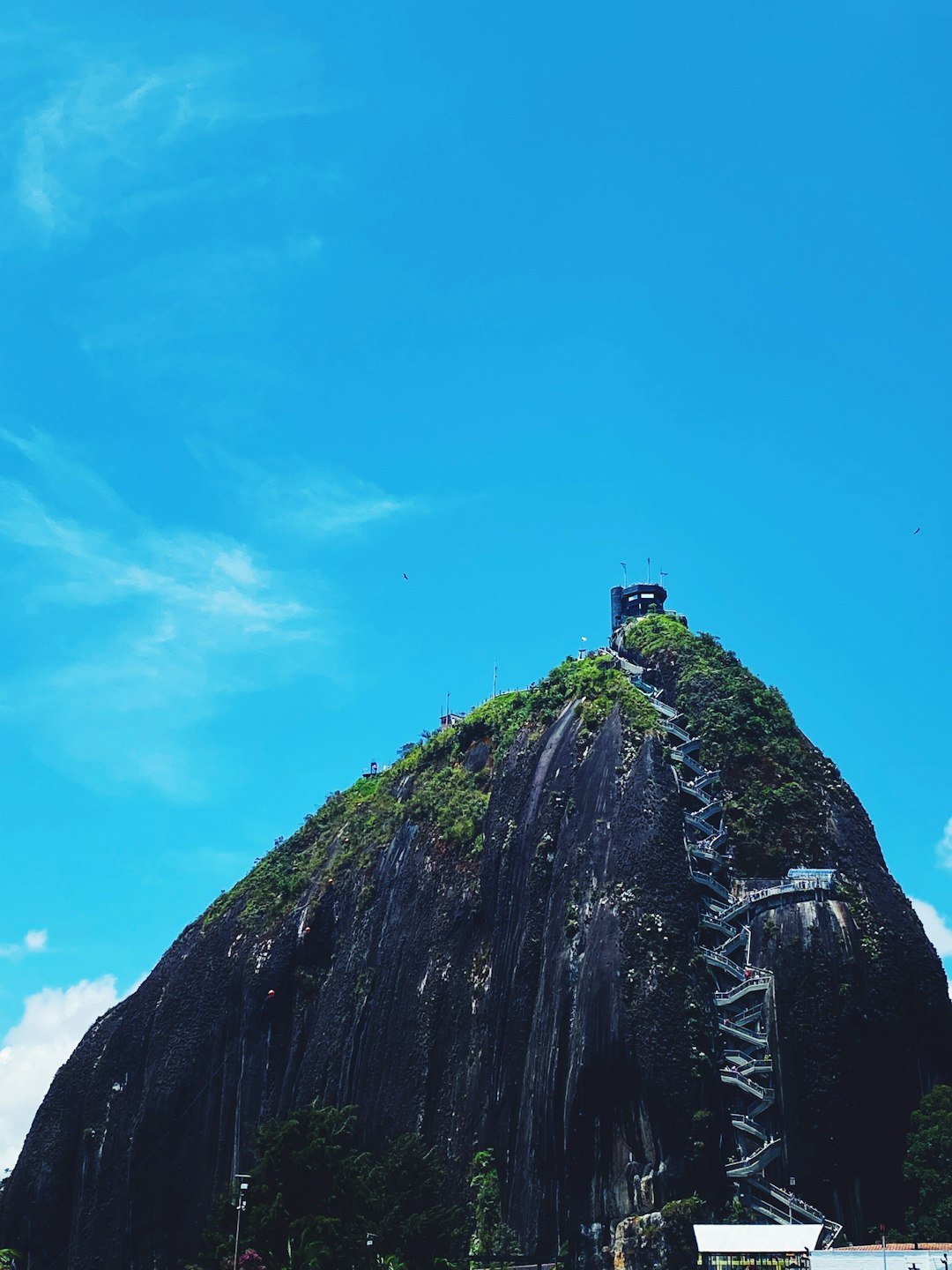
La Piedra del Peñol is a 200-metre-tall granite monolith rising from the Embalse Guatapé reservoir in Antioquia, and it is one of the most photographed places in Colombia. The view from the top - a panorama of reservoir, islands, forested hillsides, and the twin towns of Guatapé and El Peñol far below - justifies every one of the 740 steps. Coming to the Guatapé area without climbing the rock is like visiting Cartagena without seeing the walled city.
What La Piedra del Peñol Actually Is
The rock is a large geological intrusion - a single mass of granitic gneiss estimated to weigh approximately 10 million tonnes and estimated to be 70 million years old. It sits in an area of rolling hills that the Embalse Guatapé (a hydroelectric reservoir completed in 1979) partly flooded, isolating the rock and making it appear to rise directly from the water when viewed from certain angles.
The name is contested between the two neighbouring towns. Residents of El Peñol call it El Peñol; residents of Guatapé call it La Piedra de Guatapé. A political dispute in the 1980s led someone to begin painting the letters “G-U-A-T-A-P-E” across the face of the rock - the project was abandoned after the “G” and part of the “U” were completed, and the unfinished letters remain visible on the rock face today. Neither town won the naming debate conclusively.
The Climb
The 740 steps are built into a narrow fissure that runs vertically up one face of the rock. The fissure is about 60 centimetres wide at points and the steps are unevenly spaced - some gentle, some steep. There are handrails throughout and rest platforms at intervals where vendors sell water (COP 3,000 to 5,000 per bottle), soft drinks, and light snacks.
Most fit adults complete the climb in 20 to 30 minutes, though the thin air at altitude (the summit sits at around 2,135 metres above sea level) can make the upper section feel more demanding than expected. Descending takes approximately 15 minutes. Comfortable trainers are adequate; hiking boots are unnecessary but flip-flops are awkward on the descent.
At the top, a small viewing platform with railings covers the summit. There are also a café and small souvenir shop at the top. On a clear day the visibility extends across the entire reservoir system - a landscape of irregular blue-water inlets, green islands, and forested ridgelines that extends to the horizon in all directions.
Entry Fee and Opening Hours
Entry to La Piedra del Peñol costs approximately COP 25,000 for foreign visitors as of 2026. Colombian nationals and residents pay a reduced rate. There is no advance booking system - tickets are purchased at the base on arrival.
The rock opens at approximately 7am and closes in the late afternoon (times vary seasonally, roughly 5–6pm). Weekend hours are extended in peak season. Arrive before 9am to avoid queues.
Getting to La Piedra del Peñol
From Guatapé town: The rock is approximately 2 kilometres from Guatapé’s main plaza. You can walk (25 minutes on a flat road), take a tuk-tuk (COP 5,000 to 8,000 per person), or hire a bicycle. Most guesthouses in Guatapé can arrange transport or point you toward the tuk-tuk rank near the lake.
From Medellín: La Piedra is most often visited as a day trip from Medellín. Direct minibuses (buses) depart from the Terminal del Norte in Medellín to either Guatapé or El Peñol (the bus stops closest to the rock are at El Peñol, about 500 metres away). Journey time is approximately 2 hours and fares run COP 16,000 to 20,000 each way as of 2026. Buses depart regularly from around 5:30am. The last bus back to Medellín departs around 5–6pm - confirm the time on the day.
Organised tour from Medellín: A guided day trip from Medellín to Guatapé typically includes the minibus, entry to the rock, a boat tour of the reservoir, and lunch. Prices run approximately USD 35 to 65 per person as of 2026 depending on group size and inclusions. The convenience is real - the guide handles logistics and the boat tour adds significant value to the day.
What to Do After the Climb
Once you descend the rock, the day is not over. Guatapé town is 2 kilometres away and worth at least a couple of hours - the painted zócalos (decorative bas-relief tiles covering the lower third of almost every building) are unique in Colombia and the lakeside restaurants serving bandeja paisa, fried fish, and sancocho de gallina (chicken stew) are a good reason to stay for lunch. Expect to pay COP 25,000 to 45,000 for a full meal at the lakeside restaurants.
Search hotels in Guatape on Booking.com
Boat tours of the reservoir operate from the Guatapé waterfront and take you around the small islands and flooded village ruins (the original El Peñol town is partially submerged and visible at low water). One-hour tours cost approximately COP 25,000 to 35,000 per person as of 2026. Longer sunset tours are available for approximately COP 50,000 per person.
What to Bring
- Water and snacks (available at the base and midway up, but cheaper to bring your own)
- Sunscreen - the rock has no shade on the upper section and the Andean sun is strong
- A light jacket for the summit (temperatures drop and wind picks up above 2,100m)
- Cash - the ticket booth and most vendors at the rock do not accept cards
Weekend Crowds
La Piedra sees significant crowds on weekends, particularly on Saturdays when Medellín residents arrive in large numbers from mid-morning. The steps become slow and congested between about 10am and 2pm. If you are visiting on a weekend, commit to arriving at opening time (7am). Weekday visits are consistently more comfortable.
More on Guatape: things to do in Guatape and Guatape travel guide.