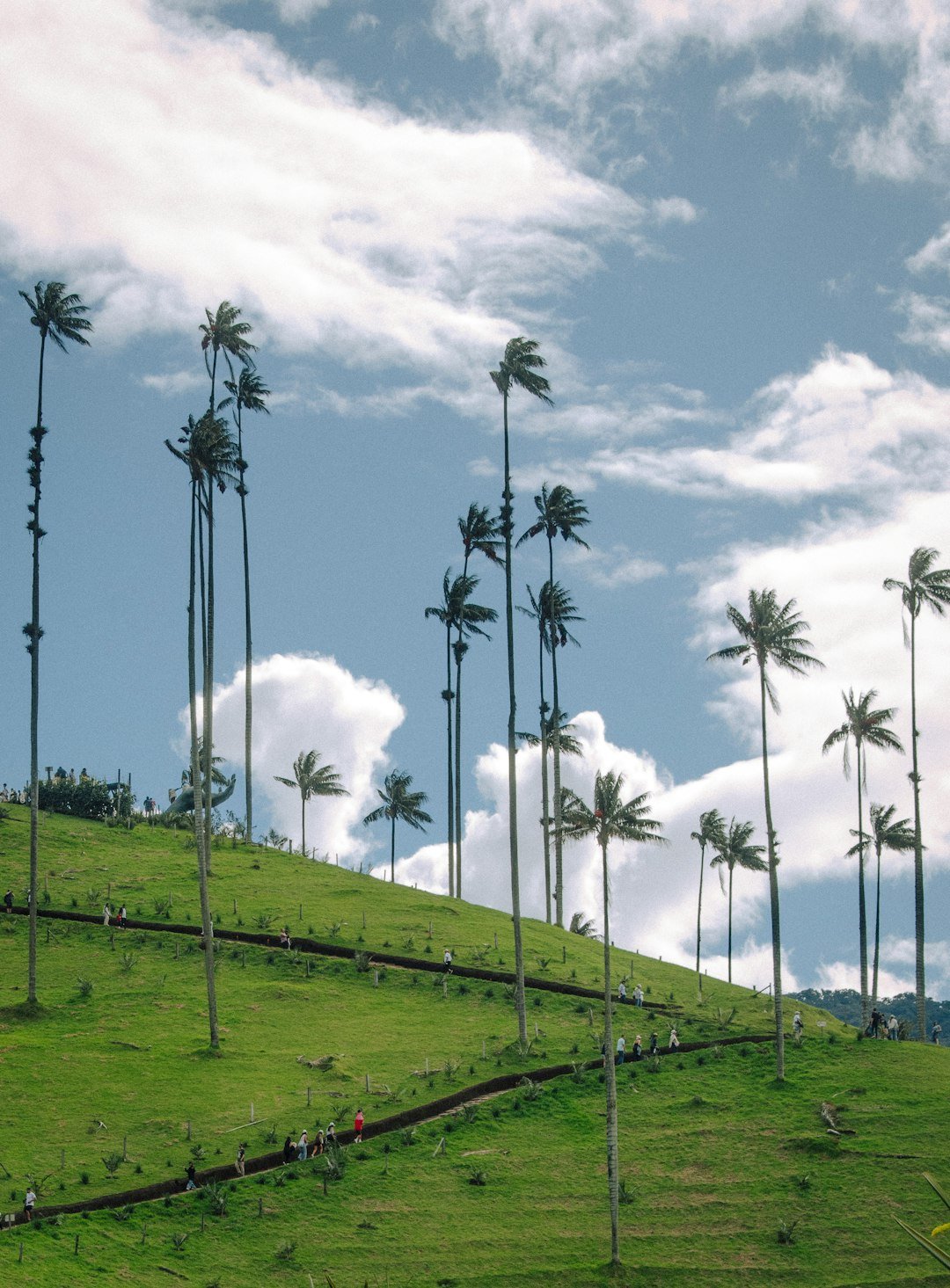
The Cocora Valley is Colombia’s most dramatic landscape that is not a Caribbean beach. A high Andean valley in the Quindío department of the Coffee Region, it is home to the wax palm (Ceroxylon quindiuense) — the world’s tallest palm tree and Colombia’s national tree — which rises in improbable columns to heights of 60 metres and above, standing alone across misty grass slopes as if placed by a film crew. The surrounding cloud forest holds a remarkable density of hummingbird species. The whole package — wax palms, cloud forest, birds, and mountain air — is accessible as a half-day walk from Salento, and the full loop hike is one of the best things to do in Colombia.
The Wax Palms: What You’re Actually Looking At
The wax palm is a palm tree unlike any other on earth. It grows in the high Andean cloud forests of Colombia between 1,800 and 3,000 metres altitude, and in the Cocora Valley it has found conditions that allow it to reach extraordinary heights. The tallest specimens top 60 metres — taller than any other palm species anywhere. They grow slowly (decades to maturity) and cannot regenerate in grazed pastureland, which is why the valley’s population is in long-term decline despite the trees’ protected status.
In the morning light, with mist sitting in the valley below and the palms emerging above it, the Cocora Valley is genuinely one of the most unusual landscapes you will see anywhere in the Andes. The photos you have seen online do not exaggerate — they are, if anything, more striking in person because the scale of the trees relative to the surrounding hills is difficult to convey in two dimensions.
The Loop Hike: Step by Step
The standard Cocora Valley experience is a loop hike that takes in both the open wax palm grassland and the cloud forest section, with several hummingbird sanctuaries along the way.
Starting point: Jeeps (Willys 4WD vehicles) depart from the main plaza in Salento for the Cocora Valley trailhead. Departures run from approximately 6:30am and cost around COP 5,000 to 8,000 per person as of 2026. The journey takes 20 to 25 minutes on a dirt road. The last jeep back to Salento departs the trailhead at approximately 6pm.
The route (most common direction): Start at the trailhead on the valley floor. Take the right-hand fork initially — this sends you into the cloud forest via a series of wooden bridges across the Río Quindío. The cloud forest section takes approximately 2 to 2.5 hours and passes through dense, mossy vegetation with good bird cover. After the forest, you emerge at the hummingbird sanctuaries.
Hummingbird sanctuaries: Two private fincas along the route — Finca La Montaña and Acaime — operate hummingbird feeding stations visited by multiple endemic species. At peak times (morning, dry season) you may see 10 to 15 species hovering simultaneously around the feeders. Entry costs approximately COP 3,000 to 5,000 per person, which typically includes a cup of hot chocolate. This is one of the most accessible and reliable hummingbird-viewing spots in South America.
Return via the wax palms: After the sanctuaries, the return leg crosses open grassland studded with the iconic wax palms. This section takes approximately 1 to 1.5 hours back to the trailhead. The palms are best lit in the morning — if you start early, you hit the cloud forest when the birds are most active and reach the open valley section in late morning when the light is good.
Total distance and time: Approximately 14 to 16 kilometres, 4 to 6 hours. Bring water and a snack from Salento — there is food at the hummingbird fincas but nothing substantial.
Horse Riding in the Valley
If the full loop hike is more than you want, or if you want to add to it, horses are available for hire at the trailhead for approximately COP 30,000 to 50,000 per person as of 2026. Guided rides of 1 to 2 hours take you through the most photogenic open section of the valley — the wax palm grassland — but do not cover the cloud forest or hummingbird sanctuaries.
Horse riding in the Cocora Valley is one of the more memorable experiences in the Coffee Region regardless of your prior riding experience. The horses are well-accustomed to beginners and the guides set an appropriate pace. Book your horse at the trailhead on arrival — there is usually availability, but demand is high on weekends.
What to Wear and Bring
- Waterproof jacket: The cloud forest section can be wet even on nominally clear days; mist and light rain are common throughout the year
- Sturdy shoes or hiking boots: The cloud forest trail is muddy and uneven; trainers work on dry days but hiking boots are better for grip
- Water: At least 1.5 litres per person — the trail has no water sources after the trailhead
- Snacks: Bring something from Salento; the finca sanctuaries sell drinks and hot chocolate but no full meals
- Cash: Entry to the hummingbird sanctuaries and horse rentals are cash only
- Layers: Temperature in the valley starts around 10–14°C in the morning and can feel cold in the cloud forest
Getting to Cocora Valley from Salento
The Willys jeeps from Salento’s main plaza are the standard and only practical option if you are not on a guided tour. Fare approximately COP 5,000 to 8,000 per person each way as of 2026. Jeeps depart when full (typically 6 people), so there is rarely a long wait in the morning. The last jeep back departs the trailhead at approximately 5:30–6pm.
Guided hiking tours of the Cocora Valley from Salento (or from Medellín and Armenia) are available for approximately USD 25 to 45 per person and include transport, a naturalist guide, and sometimes lunch. Worth it if you want to identify the bird and plant species along the trail.
Practical Notes
Altitude: The Cocora Valley sits at approximately 1,900 metres at its floor and the cloud forest section climbs to 2,400 metres or higher. If you have arrived recently from sea level, give yourself a day at Salento’s altitude (1,900m) before attempting the full loop.
Rain gear: The Coffee Region receives significant rainfall, and the Cocora Valley is consistently wetter than Salento town. Bring a jacket even if the morning looks clear.
Search hotels in Salento on Booking.com
Crowds: Weekends in the Cocora Valley are busy from around 10am when the jeeps from Salento fill up. Starting at 6:30 or 7am puts you well ahead of the main traffic, both on the trail and at the hummingbird sanctuaries.