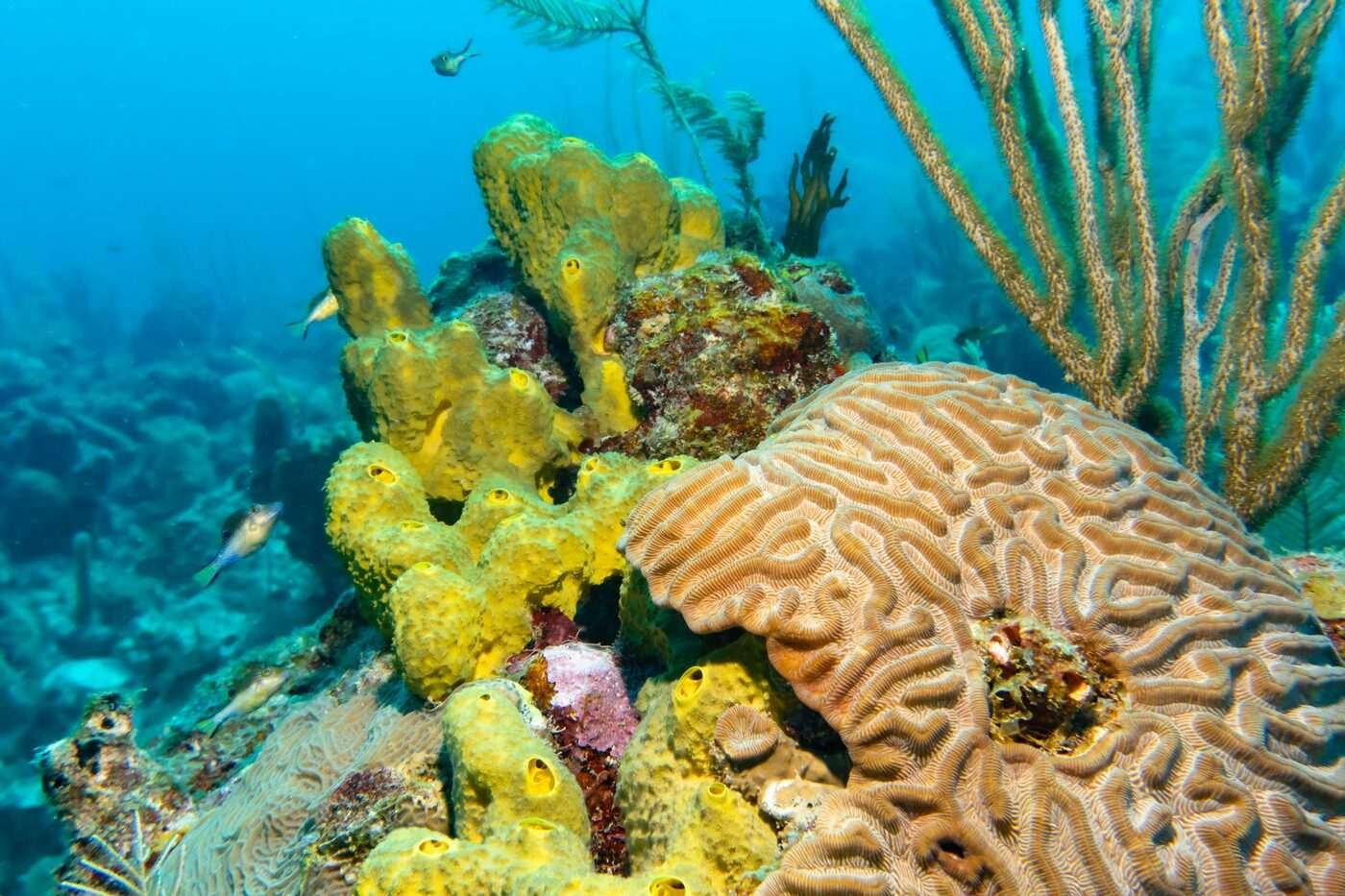
Providencia’s reef is one of the Caribbean’s best-kept secrets - partly because the island’s remoteness limits visitor numbers, and partly because the Old Providence McBean Lagoon National Natural Park has enforced restrictions that have allowed the reef to recover to a condition most Caribbean destinations can no longer claim. The Seaflower Biosphere Reserve, of which Providencia forms the core, is a UNESCO-designated marine zone encompassing some 300,000 km² of Caribbean sea, but the actual reef within reach of snorkellers here is measurably healthier than what you’ll encounter at most regional benchmarks.
What this means in practice: nurse sharks resting on the sandy bottom in clear water, hawksbill turtles moving through sea grass beds, dense coral heads in the inner lagoon that are not bleached or overgrown with algae, and visibility that regularly reaches 20+ metres in the dry season. You don’t need scuba certification to access much of this - the inner lagoon is snorkel depth throughout.
Crab Cay - The Standout Snorkel Spot
Crab Cay (Cayo Cangrejo) is a small, heavily forested islet at the northern end of Providencia’s inner lagoon, about 1 km from the barrier reef. Reaching it requires a 10-minute boat ride from the Freshwater Bay dock, but once there you’re in water between 1 and 4 metres deep with the clearest conditions on the island.
What you’ll see: Nurse sharks are the signature encounter - they rest motionless on the sandy bottom in groups of two to five and are entirely accustomed to snorkellers. At no point do they need to be approached or touched; they are simply present in the water column at snorkelling depth. Hawksbill turtles feed on the sea grass beds at the edges of the cay. Schools of grunts, queen angelfish, stoplight parrotfish, and trumpetfish are routine. On a good day with calm water, you’ll see more marine life in 45 minutes at Crab Cay than on a full day of snorkelling in San Andrés.
Coral: The reef heads around Crab Cay have good coverage of brain coral, star coral, and elkhorn coral. This is notable because elkhorn has declined severely across the wider Caribbean due to disease and warming events; seeing healthy colonies is increasingly rare.
How to access: No self-guided boat hire is available to Crab Cay. You need to go with a dive operator or via a snorkel-specific trip from the Freshwater Bay dock. Sirius Dive Shop and Felipe Diving both run snorkel trips to Crab Cay as part of their daily programme.
Snorkel trip prices: Approximately COP 60,000–80,000 per person including equipment, boat transport, and guide as of 2026. Duration: typically 2–3 hours including transit time.
Old Providence McBean Lagoon National Natural Park
The McBean Lagoon park encompasses the barrier reef running along Providencia’s eastern and northern shores - 32 km of reef structure in various depths. The outer wall, where the reef drops from 12 metres to beyond 40, is primarily a scuba diving zone. The inner sections of the lagoon are accessible to snorkellers on calm days.
Park entry fee: Approximately COP 15,000–20,000 per person as of 2026, collected at the park entrance near the Felipe Diving base on the island’s eastern coast. This fee is separate from and in addition to the island tourist card.
Access: Most of the park’s snorkelling is accessed via boat from operators in the Southwest Bay or Freshwater Bay areas. The park entrance on the eastern coast is reachable by mototaxi (approximately COP 8,000–12,000 from the main settlements).
Key zones for snorkellers:
- The inner lagoon near the park entrance: Shallow (1–6 metres), sandy-bottomed with coral heads. Good for beginners and children comfortable with masks. Turtle sightings common.
- Around Crab Cay (within park boundaries): Described above - the best non-diving snorkel experience in the park.
- Buffalo Reef: Primarily a dive site (6–18 metres) but the shallower sections at 6–8 metres are accessible to confident snorkellers with a long diving breath. Dense coral heads, good fish density.
Best months for McBean Lagoon: December through April for maximum visibility (20–30 metres on clear days). August–September sees more swell and lower visibility; some outer reef boat trips are cancelled during this period.
The Seaflower Biosphere Reserve - Context
The Seaflower Biosphere Reserve covers the marine area surrounding both San Andrés and Providencia, with the majority of the truly pristine reef in the Providencia zone. UNESCO designated it in 2000 for its exceptional biodiversity - over 300 species of coral, 400 species of fish, and nesting sites for hawksbill and green turtles.
The reserve’s core zone (where the most critical habitats are protected) runs along Providencia’s eastern shore, overlapping with the McBean Lagoon park. Restrictions on commercial fishing, dredging, and tourism activity within the core zone are legally enforced, which is a primary reason the reef remains in the condition it does.
For snorkellers this context matters: the marine life you encounter in Providencia is not maintained through artificial feeding or marine park theatre, it’s a genuinely functional reef ecosystem. The nurse sharks are not domesticated. The turtles have not been tagged or conditioned to human presence. The coral cover is the result of protection and relatively low visitor numbers.
Reef-safe sunscreen: Mineral sunscreens (zinc oxide or titanium dioxide) are mandatory within the Seaflower Reserve. Chemical sunscreens containing oxybenzone and octinoxate are demonstrably harmful to coral. They are not supposed to be used in park waters and responsible operators will refuse to take you on water if you’re visibly wearing standard sunscreen.
Snorkelling Operators in Providencia
Sirius Dive Shop: Based in Freshwater Bay, Sirius runs both scuba and snorkel programmes to Crab Cay and the inner lagoon. One of the two established operators on the island (alongside Felipe Diving), with a reliable fleet of small boats and a stock of snorkel equipment in good condition. Snorkel trip: approximately COP 60,000–80,000 per person. Scuba discovery dive (no certification required): approximately COP 180,000–220,000. Certified two-tank dives: COP 250,000–320,000 as of 2026.
Felipe Diving: Based at the McBean Lagoon park entrance on the eastern coast. Better positioned for barrier reef dives (outer wall, The Corridor) but also runs inner lagoon snorkel trips. Particularly recommended for experienced divers targeting the wall. Prices comparable to Sirius.
Booking: Both operators have limited boat capacity. Advance contact (ideally before arriving on the island) is strongly recommended, particularly for peak season (December–January) or outer reef trips. Providencia has no tourist infrastructure for last-minute problem-solving - if the boats are full, they’re full.
Equipment quality: Both operators maintain snorkel gear adequately. Bringing your own mask guarantees the best fit, particularly if you wear glasses or have a narrow face where standard masks don’t seal. Fins and snorkel vest can usually be borrowed without issue.
The Reef vs San Andrés - A Specific Comparison
For those planning to snorkel on both islands:
San Andrés’s best snorkelling is at Acuario (accessed by tour boat) and West View (shore entry). Both offer decent reef fish, starfish, and occasional rays. Acuario is the more dramatic visual experience - the water colour is exceptional - but marine life density and coral health are lower than Providencia.
Providencia’s Crab Cay surpasses San Andrés’s best snorkel spots on all marine life metrics: more nurse sharks, more turtles, healthier coral, cleaner water, and meaningfully better visibility on average. If you have to choose one island for snorkelling, Providencia is the correct choice. If visiting both (the recommended approach), save the more intensive reef exploration for Providencia and use San Andrés for the visual spectacle of the Sea of Seven Colors boat circuit.
Practical Details
Water temperature: 27–29°C year-round. A rash guard is sufficient for UV protection; a wetsuit is not required for snorkelling.
Visibility calendar: Peak visibility December–April (20–30 metres). July–August moderate. September–October lowest (heavy swell seasons, some tours cancelled).
Children: The Crab Cay lagoon (1–4 metres) is good for children comfortable with masks. No strong currents in the inner lagoon. Not suitable for non-swimmers.
Underwater cameras: The water clarity makes this one of the better snorkel photography destinations in the Colombian Caribbean. A basic GoPro mount works well in the conditions.
What to carry: Reef-safe sunscreen, rash guard or UV shirt, waterproof bag for phone, sufficient COP cash (card payment is not available at park entrance or dock-side operators).
Book a Dive or Tour
Diving and snorkelling trips in the San Andrés and Providencia archipelago can be booked before you leave the mainland. For scuba experiences with hotel pick-up and English-speaking instructors:
| Activity | From Price | |
|---|---|---|
| San Andrés: SCUBA Diving Experience with Hotel Pickup | from $65 | Book |
| San Andrés: Guided Scuba Diving Trip with Hotel Transfer | from $65 | Book |
Note: Providencia’s own operators (Sirius Dive Shop and Felipe Diving) must be booked directly on the island. The above options are for the San Andrés leg of your trip.
For accommodation: Search hotels in Providencia on Booking.com
To get there: Compare flights to Colombia and the islands
More on Providencia: where to stay in Providencia and Providencia travel guide.