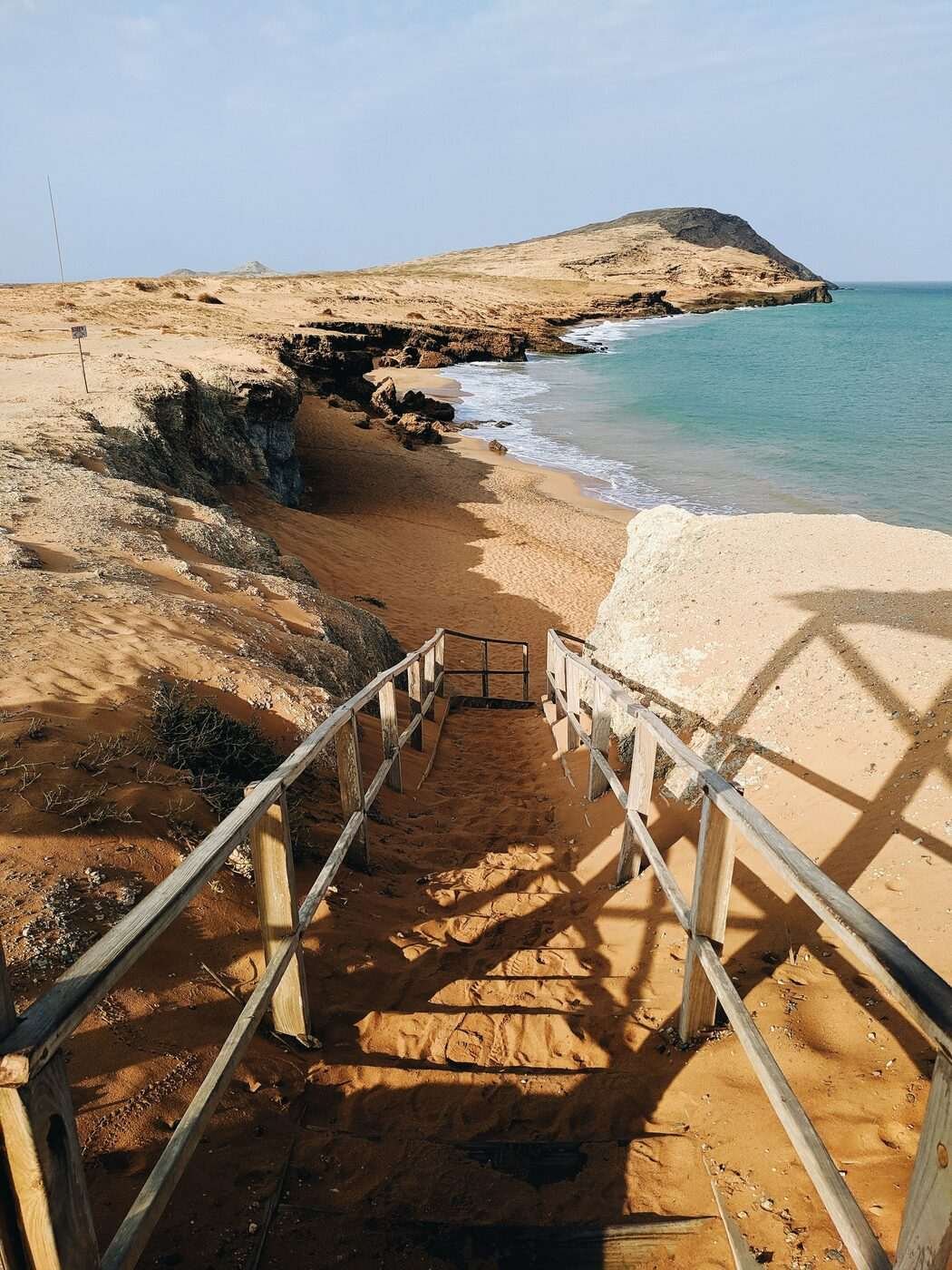
La Guajira is the part of Colombia that looks like it shouldn’t be there. A semi-desert peninsula stretching into the Caribbean at the country’s northernmost point, it is home to the Wayuu - Colombia’s largest indigenous group - and to landscapes more associated with the Sahara than South America: red and orange sand dunes dropping directly into turquoise sea, flamingo-filled lagoons, goat herds crossing arid plains. It is remote, hot, and unlike anywhere else in the country.
Getting here requires commitment. Flights connect Bogota and Medellin to Riohacha (the department capital), or buses run from Santa Marta (3 hours). From Riohacha, the main destinations - Cabo de la Vela and Punta Gallinas - require a 4WD over unpaved roads that can take three to five hours each way. Most visitors join a tour from Riohacha or Santa Marta that handles all logistics.
Cabo de la Vela
Cabo de la Vela is a small fishing village at the western tip of the Guajira peninsula, roughly four hours from Riohacha by 4WD. The village itself is basic - a handful of rancherías (Wayuu family lodges), a few restaurants serving fried fish and arepas, no reliable electricity after midnight. The draw is the physical setting: red cliffs dropping to a completely empty turquoise bay, a lighthouse viewpoint that catches the sunset over the Caribbean, and kitesurfing conditions that attract riders from across South America.
Pilón de Azúcar (Sugar Loaf) is a sacred hill above Cabo de la Vela with a small shrine at the top. The 20-minute walk up gives the best panoramic view of the bay and the surrounding desert. The walk is significant to the Wayuu as a place of spiritual importance - treat it accordingly.
The kitesurfing conditions at Cabo de la Vela (December to April, consistent trade winds) are among the best in Colombia. Schools operate on the beach charging approximately COP 180,000 to 250,000 per hour for lessons as of 2026; full equipment rental is available.
Playa del Pilón below the sugar loaf hill is one of the most visually striking beaches in Colombia - an empty sweep of white sand backed by red cliffs. Swimming here requires caution: the open-water currents can be strong. The sheltered bay closer to the village is safer.
Punta Gallinas
Punta Gallinas is the northernmost point of South America. A small collection of rancherías sits at the tip of the peninsula beside a lagoon where flamingos feed. The sand dunes here - the Dunas de Taroa - rise directly from the Caribbean and are the only coastal dunes in South America, according to the Wayuu. Climbing them takes about fifteen minutes; the descent is by running or sliding.
From Punta Gallinas, the view is an odd combination of sand, desert scrub, turquoise sea, and the open Atlantic horizon. It is isolated by any measure - no roads go further north in South America from here.
The journey from Cabo de la Vela to Punta Gallinas takes approximately two to three hours by 4WD depending on conditions. Most overnight tours include a night at both Cabo de la Vela and Punta Gallinas; single-night tours skip one or the other.
Accommodation at Punta Gallinas is exclusively in rancherías - family-run guesthouses in traditional Wayuu-style structures with hammocks rather than beds in many cases, and shared outdoor bathroom facilities. Meals are included in most packages: typically fish, rice, plantain, and fresh juice. Electricity runs from a generator for a few hours in the evening.
Flamingo Lagoons near Riohacha
The Ciénaga de los Flamencos sits near the town of Camarones, roughly 30 km east of Riohacha. Flamingos feed in this coastal lagoon year-round, with populations peaking during migration seasons (October to January). Local boatmen offer 45-minute to 1-hour tours into the lagoon for approximately COP 15,000 to 30,000 per person as of 2026.
The lagoon is accessible as a half-day trip from Riohacha by colectivo (shared jeep, COP 5,000 from the main market) before or after the main Guajira circuit. Binoculars are useful - flamingos stay in the shallower areas away from the boat landing.
Wayuu Cultural Visits
The Wayuu people make up approximately 45 percent of La Guajira’s population and have maintained a distinctive culture, language, and governance structure through Spanish colonisation and into the present. Their traditional crafts - woven mochilas (bags), hammocks, and bracelets - are made by women and represent a sophisticated textile tradition. Good-quality mochilas in Riohacha’s market cost approximately COP 80,000 to 250,000 depending on size and complexity; the larger finely-woven pieces can cost significantly more.
Ranchería visits on organised tours give a basic introduction to Wayuu family life. The more substantive visits, arranged through specialist tour operators in Riohacha, include time with artisan families, an explanation of the Wayuu clan system, and meals prepared by community members. These cost approximately COP 150,000 to 250,000 per person for a half-day visit.
Riohacha
Riohacha, the department capital, is the logistical hub for La Guajira. It has a long malecón (seafront promenade) worth an evening walk, a market with Wayuu crafts and hammocks, and several restaurants serving fresh Caribbean fish. The city itself is not a destination but a base - arrive the day before your Guajira tour departs and use the malecón for orientation and a meal.
Practical Notes
Water: La Guajira has significant water scarcity issues. Bring more water than you think you need. Rancherías provide water for basic needs but the supply is limited.
Sun protection: The combination of desert heat, altitude (Punta Gallinas is at sea level but the UV index is extreme), and reflected light from sand and water is punishing. High-SPF sunscreen, a hat, and long sleeves are essential.
Cash: There are no ATMs beyond Riohacha. Bring all the cash you need for your entire trip before leaving the city - rancherías and village vendors are cash-only.
Tour operators: Tours from Riohacha or Santa Marta run two-night, three-day circuits covering Cabo de la Vela and Punta Gallinas for approximately COP 450,000 to 700,000 per person depending on group size and accommodation standard. The price typically includes 4WD transport, accommodation in rancherías, and meals. Transport only (for those with their own camping gear) is cheaper.
Search hotels in La Guajira on Booking.com
Tours and Day Trips
| Tour | Duration | From Price | |
|---|---|---|---|
| La Guajira: Cabo de la Vela & Punta Gallinas | 3 days | varies | Browse |
| Browse all La Guajira tours | - | - | Browse |
For accommodation in the region, see our guide to where to stay in La Guajira. For the broader department context, see the La Guajira travel guide.