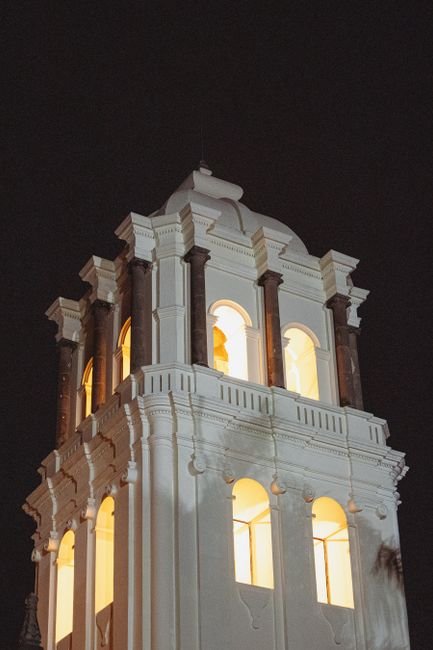
Popayán has been a significant city in Colombian history since its founding by Sebastián de Belalcázar in 1537. For three centuries it was one of the most important cities in the Audiencia de Quito - a centre of colonial administration, religious education, and trade between the Andean highlands and the Pacific coast. That history is physically present in one of the best-preserved colonial centres in Colombia, rebuilt faithfully after the 1983 earthquake that destroyed much of the city. The reconstruction effort is itself part of what makes Popayán architecturally significant.
The Historic Centre and Colonial Architecture
Browse Popayán tours on GetYourGuide for guided colonial city walks, day trips to Purace volcano, and Silvia market excursions with free cancellation.
The core of Popayán’s appeal is the walkable historic centre - a 10-by-10 block grid of whitewashed colonial buildings, churches, plazas, and convents that has maintained its visual coherence more successfully than almost any comparable Colombian city.
Parque Caldas: The main plaza, formally named after Francisco José de Caldas (the Colombian scientist and patriot), is the social and spatial centre of the historic district. Surrounded on all sides by colonial buildings, with the Catedral Basílica Nuestra Señora de la Asunción on the north side and the Palacio Nacional on the east. The benches fill with students and local residents throughout the day - it functions as a genuine public space rather than a tourist set piece.
Catedral Basílica Nuestra Señora de la Asunción: The cathedral on Parque Caldas was severely damaged in the 1983 earthquake and rebuilt using the original 18th-century plans. The interior has a single nave with side chapels and a noticeably clean, austere quality compared to many Colombian cathedrals. Free entry; open daily 7am to 8pm. Mass at 7am, 12pm, and 6pm.
Iglesia de San Francisco: The most photogenic colonial church in Popayán - the baroque facade facing Carrera 9 is the standard postcard image of the city. The interior has 17th-century retablos (altar screens) that survived the earthquake in reasonable condition. The attached convent (Convento de San Francisco) houses the Museo de Arte Religioso. Entry to the church free; museum entry approximately COP 5,000.
Iglesia Santo Domingo and La Ermita: Two further colonial churches within a short walk of Parque Caldas. La Ermita (1546), on the hill above the historic centre, is the oldest church in Popayán and gives the best elevated views over the white rooflines of the city.
Museo de Arte Religioso
The Museum of Religious Art in the Convento de San Francisco holds one of the most important collections of colonial-era religious art in southern Colombia - silverwork from the colonial period, processional figures used in Semana Santa, paintings, and liturgical objects. Many pieces date from the 16th and 17th centuries.
Entry approximately COP 5,000 per adult. Open Tuesday to Saturday 9am to 12:30pm and 2pm to 5:30pm, Sunday 9am to 12pm. The guided visit (ask at the entrance) adds context that the labels alone do not provide.
Casa Museo Negret and Iberoamerica
Popayán’s most internationally significant artist - sculptor Edgar Negret - has a dedicated museum in the colonial house where he was born and worked. The Casa Museo Negret on Calle 5 holds the largest collection of Negret’s abstract metal sculptures in Colombia, as well as a separate gallery (Museo Iberoamerica) focused on Latin American art of the 20th century.
Entry approximately COP 6,000 for the combined museums. Open Tuesday to Sunday 9am to 1pm and 2pm to 5pm. The sculpture collection is worth the visit even for visitors unfamiliar with Negret’s work - the abstract steel pieces are striking in the colonial courtyard setting.
The Puente del Humilladero
The Puente del Humilladero (Bridge of Humiliation) is a multi-arch colonial bridge over the Molino river at the edge of the historic centre. Constructed in the late 18th century, it is one of the most photographed structures in Popayán and gives a view of the church towers and white rooftops of the colonial core. The bridge is free to walk and most impressive in the early morning before traffic builds.
Semana Santa Processions
The Popayán Semana Santa processions are the defining cultural event of the city and one of the most significant religious observances in South America. The tradition dates to the 16th century and has continued without interruption (even after the 1983 earthquake, when processions were held amid the ruins). UNESCO listed the processions as an Intangible Cultural Heritage of Humanity in 2009.
The processions run Monday through Saturday of Holy Week, each carrying a different religious image through the streets of the colonial centre in candlelit processions that begin at nightfall and continue until the early morning hours. The Thursday night (Procession of the Holy Burial) and Friday night (Procession of the Resurrection) are the largest and most significant.
Attending: The processions are free to observe from the streets. The best viewing positions along the main routes fill early - arrive at least 90 minutes before the procession start time (typically 9pm or 10pm). The processional route circles the central blocks of the historic district; maps are distributed by the city tourism office on Parque Caldas.
Accommodation during Semana Santa: Book hotels six to twelve months in advance. All accommodation in Popayán and nearby cities fills completely. Rates increase 200% to 400% during this week.
Search hotels in Popayan on Booking.com
El Morro de Tulcán and the Statue of Belalcázar
Above the historic centre, a pre-Columbian pyramid mound (El Morro) supports a large equestrian statue of Sebastián de Belalcázar, Popayán’s Spanish founder. The hilltop gives 360-degree views over the city and the surrounding mountains, including the Puracé volcano (4,646m) visible on clear days to the southeast.
The climb takes approximately 20 minutes on a paved path from the base. Free access. The viewing platform at the top is best in the early morning before haze builds. Note: The statue of Belalcázar was toppled by indigenous protesters in 2020 and has not been replaced at time of writing - the plinth remains but is empty.
Gastronomic Congress and UNESCO Gastronomy
Popayán’s UNESCO Creative City of Gastronomy designation (2005) is one of the oldest in the network. The designation is taken seriously - the annual Congreso Gastronómico Nacional de Popayán in September brings chefs, food producers, and researchers from across Colombia and internationally.
For visitors outside September, the food culture is accessible through the city’s markets and traditional restaurants. The Galería Alameda (Calle 12 with Carrera 24) is the main market - open daily from 6am, strongest Tuesday, Thursday, and Saturday mornings. Indigenous food producers from the surrounding Cauca region bring products including pipilongo (an Amazonian pepper), chontaduro (peach palm), and various Andean tubers that rarely appear in city markets elsewhere in Colombia.
Practical Notes
Best time to visit: March and April (Semana Santa, if you plan well in advance) or September for the gastronomy congress. The rest of the year is pleasant - Popayán averages 18°C and receives rain across most months (altitude 1,737m). Bring a light waterproof jacket for afternoons.
Walking the historic centre: The main colonial sights concentrate in an area covering approximately 8 by 8 blocks. A full walking tour takes 3 to 4 hours at a comfortable pace. The Tourism Office on Parque Caldas provides free maps and can recommend English-speaking guides for approximately COP 50,000 to 80,000 per group.
Universidad del Cauca: The university occupies several colonial buildings within the historic centre and keeps the neighbourhood lively with students throughout the academic year (February to June, August to December). The main campus on Calle 5 is open to visitors and its cloistered courtyards are particularly well-preserved.