The Boyacá highlands around Villa de Leyva are dense with destinations. The region has more well-preserved colonial towns per square kilometre than anywhere else in Colombia, plus a surprising wine-producing corridor, an extraordinary salt cathedral, indigenous craft centres, and one of the country’s most overlooked colonial capitals. All of the following are reachable within an hour or two of Villa de Leyva.
Ráquira — The Pottery Village
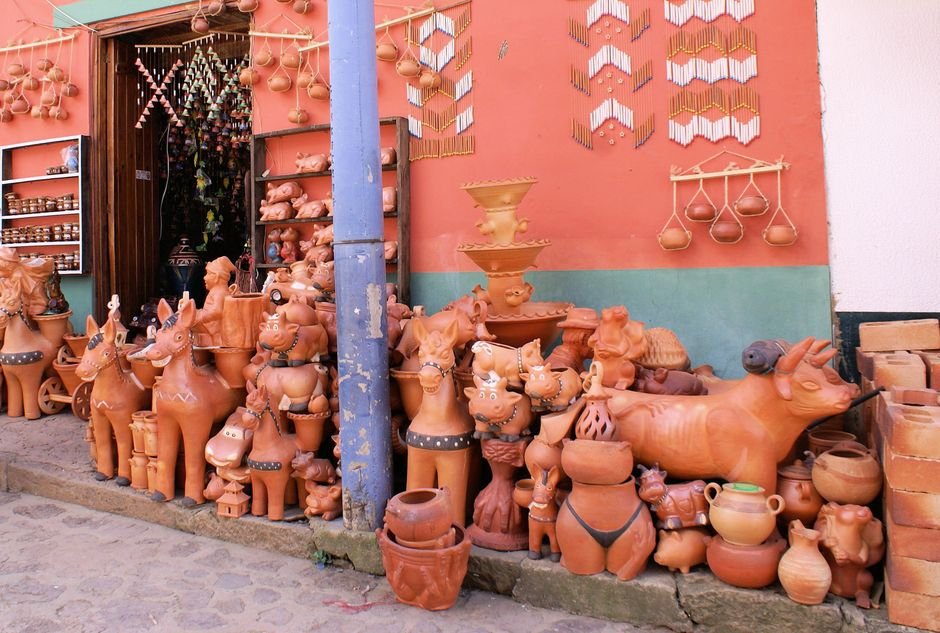
Ráquira (25km from Villa de Leyva) is entirely dedicated to pottery. Every building on the main street is covered in hand-painted geometric designs in red, yellow, and blue, and the facades are lined with ceramics for sale — from small tourist pieces to serious functional pottery. The tradition dates back to pre-Columbian Muisca pottery-making in this area, and several families have been producing here for multiple generations.
The main street is the attraction — walking it slowly, talking to the producers, and understanding the difference between tourist souvenirs and serious traditional ceramics (the latter are usually in the shops slightly off the main strip and cost more). The Muisca pottery technique uses a distinctive paddle-and-anvil method on certain pieces that is different from wheel-thrown pottery. Ask to see the production process — most shops have a working area visible from the street.
What to buy: Large decorative pieces (pots, platters, wall hangings) are the most authentic. Small tourist pieces are mass-produced and less distinctive. Traditional cooking pots (ollas de barro) are used actively in Boyacá kitchens and make meaningful purchases if you can transport them safely.
Transport: Colectivos run from Villa de Leyva’s main square toward Chiquinquirá and pass through Ráquira — approximately 45 minutes and COP 8,000 per person. Taxis charge approximately COP 40,000 one way; COP 80,000 return with waiting time (1.5–2 hours in Ráquira is enough). The colectivo return can be flagged from the main road outside Ráquira.
Combine with: The Monasterio de La Candelaria (12km beyond Ráquira toward Chiquinquirá — ask the driver) and the Sutamarchán wine corridor on the same afternoon.
Sutamarchán — Boyacá Wine Region
The municipalities of Sutamarchán, Sáchica, and Tibasosa in the Boyacá highlands form a growing wine-producing area at 2,000 to 2,400m altitude. The wines are characteristically high in acidity with distinctive fruit profiles — the altitude and UV exposure create conditions that are genuinely different from any other Colombian wine-growing context.
Viñedo Casa Quiborá (Sutamarchán): The most established winery in the Boyacá region, producing Sauvignon Blanc and Cabernet Franc under high-altitude conditions. Visits with tasting cost approximately COP 25,000 to 40,000 per person and run Saturday and Sunday from 10am to 5pm. Contact in advance for weekday visits. The winery is 28km from Villa de Leyva on the road toward Tunja.
Viñedo Los Arrayanes: A smaller producer 3km from Sutamarchán village with weekend tastings (Saturdays only, COP 20,000 per person including two wines and a bite of regional cheese). Family-run and considerably less polished than Casa Quiborá — the informal atmosphere is part of the experience.
Transport: Taxis from Villa de Leyva to Sutamarchán cost approximately COP 35,000 one way; or take any bus toward Tunja and ask to be dropped at the Sutamarchán turn-off.
Tunja — Colonial Capital of Boyacá
Tunja (40km south of Villa de Leyva, 1 hour by bus) is the departmental capital of Boyacá and has the highest concentration of colonial architecture in Colombia after Cartagena — a fact most international tourists do not know because Tunja is not marketed internationally in the same way.
Casa del Fundador Suárez Rendón: The oldest preserved secular building in Colombia (1539), the house of Tunja’s founder. The interior has original 16th-century murals painted directly on the wall surfaces — mythological figures, animals, and decorative patterns that are exceptional for their age and condition. Entry approximately COP 5,000. Open Tuesday to Friday 9am to 12pm and 2pm to 6pm, Saturday 9am to 4pm.
Iglesia Santa Clara: A 16th-century convent church with the most ornate colonial interior in Boyacá — gilded retablos, painted ceilings, and a collection of colonial-era paintings. Entry approximately COP 5,000. Open Tuesday to Sunday.
Catedral de Santiago de Tunja: The main cathedral on Parque Boyacá has a baroque facade and an interior notable for a series of paintings from the Quito school. Free entry.
Transport from Villa de Leyva: Buses run frequently from Villa de Leyva’s main bus stop toward Tunja — journey approximately 1 hour, COP 10,000 to 14,000. Return buses run until approximately 8pm.
Zipaquirá Salt Cathedral
The Salt Cathedral of Zipaquirá (90km south of Villa de Leyva toward Bogotá) is one of the most extraordinary underground spaces in South America — a cathedral built entirely within a working salt mine, featuring a sequence of 14 underground chapels carved from dark rock salt leading to a main nave with a 75-tonne cross illuminated from below.
Construction on the current cathedral began in 1991 (the original 1954 version was unsafe) and the space is still used for religious services. The scale underground is unexpectedly vast — the main nave is 23m high. Entry approximately COP 90,000 per adult including the guided tour of the cathedral and the adjacent museum of salt mining history. Open daily 9am to 5:30pm.
Transport from Villa de Leyva: Zipaquirá requires going south via Tunja and Bogotá — approximately 2 to 2.5 hours by bus (COP 25,000 to 35,000 to Zipaquirá). Easier to combine with a Bogotá visit than as a standalone day trip from Villa de Leyva. However, if travelling between Villa de Leyva and Bogotá, stopping at Zipaquirá en route adds 2 to 3 hours to the journey.
Puente de Boyacá — Independence Battle Site
14km south of Tunja, the Puente de Boyacá is the bridge where the decisive Battle of Boyacá was fought on 7 August 1819 — the battle that effectively secured Colombian independence from Spain. The site has a large monument complex, museum, and the preserved stone bridge itself.
The battle is central to Colombian national identity (7 August is a national holiday) and the site receives significant domestic visitor traffic, particularly from school groups. The monument complex and museum are free. Combined with a Tunja visit, this adds 45 minutes round trip by taxi (approximately COP 30,000 from Tunja).
Practical Notes
Most useful route: Villa de Leyva → Ráquira (morning, pottery and monastic visit) → Sutamarchán (afternoon, wine tasting) → back to Villa de Leyva for dinner. This covers the most distinctive experiences of the Boyacá highlands in a single day.
Transport booking: For most of these destinations, colectivos (shared vans) are the cheapest option and run frequently from Villa de Leyva’s main plaza. For Zipaquirá and Tunja, standard bus services from the villa de Leyva terminal are more comfortable. For wine visits requiring precise timing, hire a taxi for the half-day (approximately COP 120,000 to 180,000 for 4 to 5 hours).
Search hotels in Villa de Leyva on Booking.com
Book a Guided Tour
| Tour | Duration | From Price | |
|---|---|---|---|
| Villa de Leyva and surroundings guided day tour from Bogotá | 10 hrs | from $40 | Book |
| Fossil site and Iguaque lagoon hiking tour from Villa de Leyva | 5 hrs | from $30 | Book |
| Browse all Villa de Leyva tours | — | — | Browse |
Distances: Everything listed above except Zipaquirá is within 60km of Villa de Leyva. The road through Boyacá is winding but generally in good condition. Allow more time than the straight-line distance suggests — 40km can take 75 minutes on mountain roads.