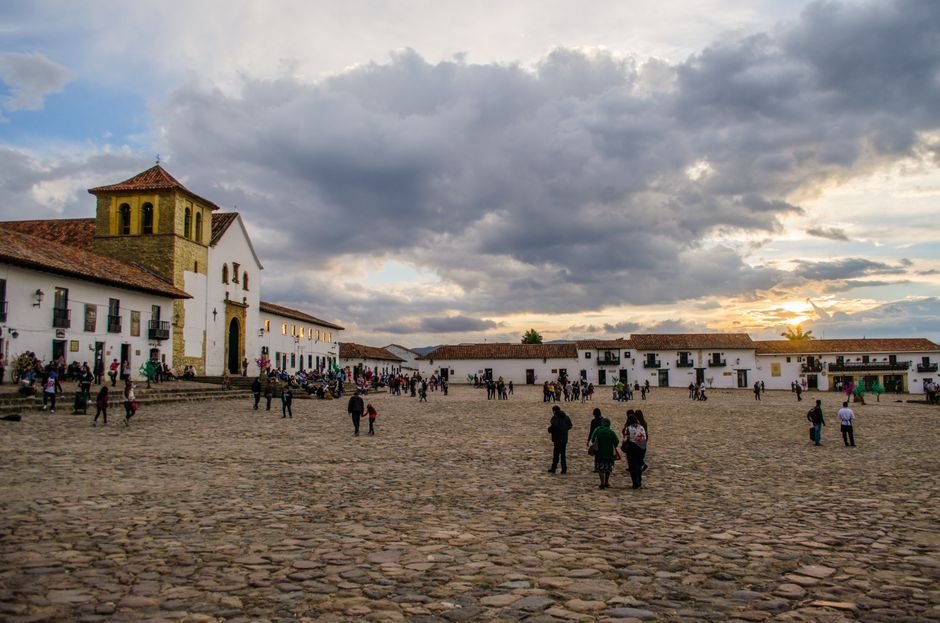
Villa de Leyva sits at 2,149m above sea level in a pocket of the Boyacá highlands that receives significantly less rainfall than the surrounding mountains — a semi-arid landscape of ochre cliffs, cactus, and dry ravines that makes it look nothing like the rest of the Andean Colombia you see elsewhere. The visual contrast between the bone-white colonial buildings, the terracotta cobblestones, and the desert terrain is striking. Founded in 1572 and declared a national monument in 1954, the town has preserved its colonial character completely — no concrete facades, no modern commercial signage, no traffic lights. It is one of the most photographed towns in Colombia for reasons that become immediately apparent.
Plaza Mayor
The Plaza Mayor is the reason the town exists in its present form. At approximately 14,000 square metres, it is one of the largest paved main plazas in the Americas — a vast flat expanse of cobblestones enclosed by two-storey whitewashed buildings on all four sides, with the Iglesia Parroquial Nuestra Señora del Rosario on the north face (begun 1608, completed late 18th century).
The scale of the plaza is disorienting in the best possible way. The space is designed for processions, markets, and public gatherings rather than comfort or intimacy — it does not have benches in the centre, just the open stone pavement and the Fuente del Peregrino (1778), a stone fountain at the east side. On clear mornings, the light from the east catches the cobblestones and turns them amber. On weekdays, the plaza is quiet enough to photograph without crowds. On weekends, it fills with Colombian day-trippers and their children.
The plaza is free to enter and open at all times. The best light conditions are early morning (6–8am) and late afternoon (4–6pm).
Iglesia Parroquial Nuestra Señora del Rosario
The colonial church on the north side of Plaza Mayor dates from the early 17th century and is one of the best-preserved colonial churches in the Boyacá highlands. The interior is single-nave, austere, with plain whitewashed walls and a wooden ceiling. The side chapels contain colonial-era paintings, some attributed to artists from the Quito school. Entry is free; hours vary around mass times (typically 7am, 12pm, 6pm).
The bell tower gives views over the plaza — access is occasionally granted by the sacristan, worth asking.
El Fósil Museum
Browse Villa de Leyva tours on GetYourGuide for guided fossil site visits, colonial town walks, and Boyacá day trips with instant booking.
Six kilometres from Villa de Leyva on the Chiquinquirá road, El Fósil displays the most extraordinary single fossil in Colombia: a nearly complete Kronosaurus skeleton measuring approximately 12 metres, found by a farmer in 1977. The Kronosaurus was a marine reptile from the Cretaceous period (approximately 100 million years ago) — a predator comparable in scale to a large whale.
The museum is small — one main hall and a few smaller display cases — but the central fossil is genuinely impressive at close range. The skeleton is articulated and largely complete; the skull alone is over 2 metres. Entry approximately COP 10,000 per adult. Open daily 9am to 5pm. The 6km journey from town costs approximately COP 10,000 to 15,000 by mototaxi or COP 25,000 by taxi.
Centro de Investigaciones Paleontológicas (CIP)
The town’s own palaeontology research centre, 3 blocks from Plaza Mayor, has a more comprehensive but less dramatic collection than El Fósil. The displays include ammonites, ichthyosaur bones, fish fossils, and fossil plant specimens from the surrounding rock formations. Explanatory panels in Spanish and English provide geological context.
Entry approximately COP 8,000 per adult. Open Tuesday to Sunday 9am to 12pm and 2pm to 5pm. The collection is weaker on presentation than El Fósil but stronger on scientific context — worth visiting if the Kronosaurus has sparked interest in the regional geology.
El Infiernito (Muisca Archaeological Site)
Five kilometres west of town, El Infiernito is a pre-Columbian Muisca archaeological site — a solar calendar built from upright stone pillars at a scale that implies significant astronomical knowledge. The stone columns (some over 2 metres tall) are thought to mark solstice and equinox alignments. Associated petroglyphs are found in the surrounding rock faces.
The site was named by Spanish missionaries who interpreted the phallic columns with alarm. It is managed by the Museo Arqueológico de Villa de Leyva. Entry approximately COP 10,000. Access by taxi from the plaza (COP 20,000 return). Open Tuesday to Sunday 9am to 12pm and 1pm to 5pm.
La Candelaria Monastery
The Monasterio de La Candelaria sits 12km from Villa de Leyva in a dry canyon — an Augustinian monastery founded in 1597, active for over 400 years without interruption, and still home to a community of friars. The architecture is severe and austere in the Augustinian tradition; the cloister and the 17th-century kitchen are particularly well-preserved.
Visits are guided by one of the monks, which makes the experience more interesting than a self-guided museum tour. Tours run at 9am, 11am, and 3pm; approximately COP 8,000 per person. Dress modestly (covered shoulders and knees required). Transport from Villa de Leyva by taxi approximately COP 30,000 to 40,000 return.
Desert and Semi-Arid Landscape Walks
The semi-arid landscape around Villa de Leyva is one of the most unusual environments at this altitude in Colombia. The soil is ochre and sandy, the vegetation is dominated by cactus and dry scrub, and the ravines cut sharply through soft rock in formations that reveal the sedimentary layers of the old Cretaceous sea bed.
Several walking trails leave from the edge of town into this terrain:
Quebrada Los Trigos: A dry ravine 2km from the plaza with exposed fossil-bearing rock. Follow the road south of town past the market and then turn onto the dirt track heading west. No entrance fee; no infrastructure. Allow 2 to 3 hours for the loop.
Cerro Los Libertadores: A hill above the west side of town with views over the plaza, the colonial rooftops, and the surrounding landscape. The path up takes approximately 40 minutes and starts from Calle 7 at the edge of the colonial grid. Free, no guide required.
Casa Museo de Luis Alberto Acuña
The house-museum of Colombian muralist Luis Alberto Acuña (1904–1994) occupies a large colonial house on the main plaza. Acuña lived in Villa de Leyva from 1942 and produced most of his significant work here — large murals synthesising pre-Columbian and colonial artistic traditions. The museum displays paintings, drawings, murals, and personal archives.
Entry approximately COP 7,000. Open Tuesday to Sunday 9am to 1pm and 2pm to 5pm. Worth visiting both for the art and for the quality of the colonial house itself.
Practical Notes
When to visit: Weekdays (Monday to Friday) for empty-plaza photography and unhurried exploration. The weekend tourist influx from Bogotá is substantial — the plaza fills, restaurant queues form, and accommodation prices increase. A Friday evening to Sunday morning visit (arriving before the crowds) or a Monday extension works well.
Search hotels in Villa de Leyva on Booking.com
Weather: Villa de Leyva’s semi-arid climate means clear skies are more reliable than elsewhere in Colombia’s highlands. The clearest period is December to February. Rain falls mainly in April to May and October to November but is less dramatic than in wetter parts of Boyacá.
Transport: Villa de Leyva has no local public transport within the town. Taxis and mototaxis cover the short distances to El Fósil, El Infiernito, and La Candelaria. The mototaxis (three-wheelers) are slightly cheaper and more fun than cars for short rural trips.