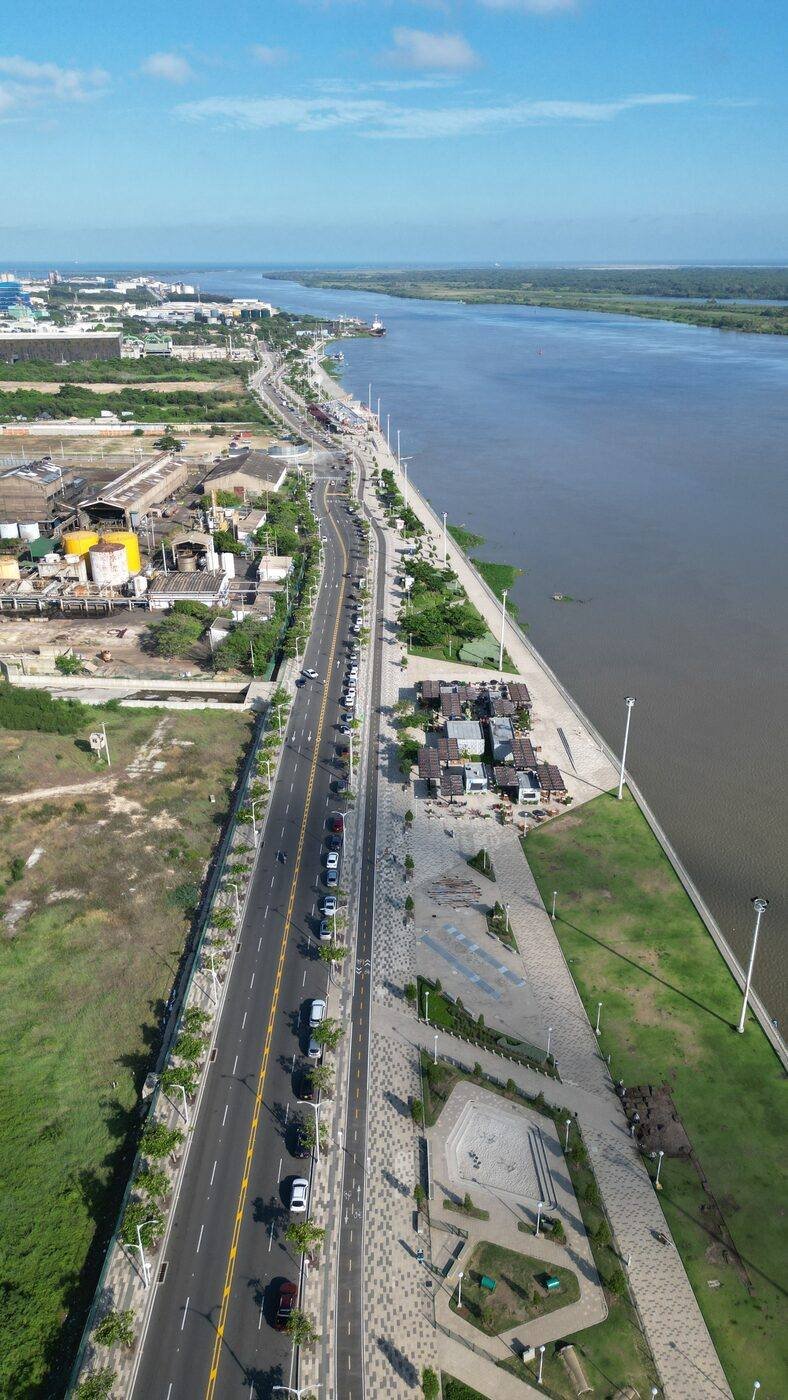
Barranquilla is a working Caribbean city, and most visitors treat it as a stopover or as a base for Carnaval. That framing undersells what sits just outside the city limits. Within a 90-minute radius you can walk the ruins of Colombia’s first international pier, move through a coastal wetland that functions as one of the most important bird habitats on the Caribbean, and stand in the house where Gabriel García Márquez was born - the same house that became, in his imagination, the fictional Macondo. None of these require a tour operator and all three can be done independently in a single day, or spread across two.
Puerto Colombia: the fallen pier
Puerto Colombia sits 20 km west of Barranquilla on the Caribbean coast. For much of the late 19th and early 20th centuries it was the primary port of entry for all imports into Colombia - a role it held because the Magdalena River mouth was too shallow for ocean-going ships. The town’s pier, built by Francisco Cisneros between 1888 and 1893, was at the time the second-longest pier in the world, stretching nearly a kilometre into the sea.
The pier was abandoned after Barranquilla’s own port infrastructure expanded, and a pair of hurricanes in the 1970s and 1990s took out most of what remained. What stands now is a series of iron pylons rising from the water, oxidised to deep rust, framing views toward the horizon in a way that feels genuinely cinematic. The beach around the pier is narrow and functional rather than pretty - vendors sell fried fish and coconut rice from plastic tables - but the ruin is striking and worth the short drive.
Getting there: From central Barranquilla, a taxi to Puerto Colombia costs approximately COP 30,000–45,000 each way (2026). Negotiate before you get in. Colectivos (shared minibuses) depart from the area around the Mercado Público on Calle 30 for around COP 5,000–8,000 per person - ask for “Puerto Colombia” and confirm the route. Journey time is 25–40 minutes depending on traffic.
On arrival: The pier and the beach in front of it are publicly accessible at no charge. Restaurants along the seafront serve whole fried mojarra (red snapper) with patacones and coconut rice for approximately COP 18,000–28,000 per plate. Bring cash; card readers are rare.
Best time to visit: Weekday mornings are quieter. Barranquilleños treat Puerto Colombia as a weekend beach escape, which means weekend afternoons are crowded and parking becomes chaotic. Arrive by 9am to have the pier mostly to yourself. The light is also better for photography in the morning, when the sun comes from the east and catches the iron pylons directly.
Isla Salamanca National Park: Caribbean mangroves and open lagoons
Isla Salamanca National Park stretches along the Caribbean coast 30–40 km east of Barranquilla, between the sea and the Ciénaga Grande de Santa Marta - one of the largest estuarine systems in South America. The park covers roughly 56,000 hectares of mangrove forest, coastal lagoons, and tidal channels, and it functions as a critical nesting and feeding ground for more than 200 bird species.
The main access point is along the Barranquilla–Santa Marta highway (Ruta Nacional 90), where a ranger station marks the formal park entrance. Paths lead into the mangrove forest from here, and boats can be arranged to explore the lagoons and channels - where herons, egrets, roseate spoonbills, and frigatebirds are reliably present. The park is also one of the few remaining habitats in this part of Colombia for the West Indian manatee, though sightings require patience and some luck.
Getting there: Take any bus or colectivo heading east toward Santa Marta from Barranquilla’s Terminal de Transportes (Calle 17 with Carrera 14). Tell the driver you want the Isla Salamanca entrance (they will know it). Journey time is approximately 30–45 minutes. The fare is around COP 8,000–12,000. A taxi from central Barranquilla costs approximately COP 40,000–60,000 each way.
On arrival: The park entrance fee is approximately COP 12,000–18,000 per person for domestic visitors; foreign visitors pay a slightly higher rate - confirm at the ranger station as fees are periodically revised by Parques Nacionales Naturales de Colombia. Guided boat tours of the lagoons can be arranged with local boatmen at the entrance for around COP 50,000–80,000 per person depending on group size and tour duration (roughly 2 hours). Bring water, sun protection, and insect repellent - the mangroves are humid and mosquitoes are active.
Best time to visit: December through March is the dry season and the most comfortable period. Birdwatching is productive year-round - migratory species peak between November and February - but the dry months mean firmer paths, lower humidity, and clearer water in the lagoons. Leave the city by 7:30am to arrive by 8am before the midday heat becomes uncomfortable.
Aracataca: Macondo in the world, not on the map
Aracataca is a small town approximately 80 km south of Barranquilla in the Magdalena department, and it is the most culturally weighted of these three day trips. Gabriel García Márquez was born here in 1927, and the town provided the emotional architecture for Macondo - the fictional Caribbean settlement at the centre of One Hundred Years of Solitude. The novel’s yellow butterflies, its banana plantations, its heat, its long afternoons - all of it originates in Aracataca.
The town is small and the pace is slow. The main draw is the Casa Museo Gabriel García Márquez, built on the site of the house where the author was born and raised by his maternal grandparents. The museum recreates the rooms as García Márquez described them in his memoir Living to Tell the Tale: the workshop of Colonel Nicolás Márquez, the dark sleeping areas, the kitchen with its earthen jars. Admission is approximately COP 8,000–12,000 (2026). Guides are available on site and are worth hiring - they contextualise the details of the house in relation to specific passages from the novels.
A short walk from the museum sits the old Aracataca train station, another structure that appears repeatedly in the novels. The station was the arrival point for the banana companies in the early 20th century, and García Márquez used it as the setting for several key scenes. The building is partially restored and open to visitors.
Getting there: Direct buses to Aracataca depart from Barranquilla’s Terminal de Transportes. Ask for buses marked “Fundación” or “Aracataca” - some Bogotá-bound buses also stop there. Journey time is approximately 1.5 hours. The one-way fare is approximately COP 18,000–25,000 (2026). Return buses operate until approximately 6pm; aim to be at the bus stop by 4:30pm at the latest to be safe.
On arrival: Aracataca’s town centre is compact and walkable. Mototaxis from the bus drop-off to the museum cost COP 2,000–3,000. Have lunch at one of the small fondas near the central park - a set lunch of soup, rice, protein, and juice runs approximately COP 12,000–16,000. The town has no tourist infrastructure to speak of, which is precisely what gives it its atmosphere.
Best time to visit: Weekday mornings are quieter and the museum is less crowded. The heat is significant year-round - Aracataca sits at low altitude in the Magdalena valley - so a morning start and a return by early afternoon is the most comfortable approach. Avoid visiting during July, which is a local festival period when accommodation in the area books out and the town is busier than usual.
Combining the trips
Puerto Colombia and Isla Salamanca can be combined in a single day if you have private transport, as both sit along the Caribbean coast - Puerto Colombia to the west, Isla Salamanca to the east. Visit Puerto Colombia first (morning), then drive east through Barranquilla and continue to the Isla Salamanca entrance (late morning to early afternoon). This works best on a weekday to avoid traffic.
Aracataca is a separate day given the 1.5-hour journey each way. If you are based in Barranquilla for three or more nights, allocate one morning for Puerto Colombia, one full day for Aracataca, and one morning or half-day for Isla Salamanca.
For organised excursions from Barranquilla with guides, hotel pick-up, and free cancellation: browse Barranquilla tours and day trips.
Browse hotels in Barranquilla on Booking.com before you go.
More on Barranquilla: things to do in Barranquilla, getting around Barranquilla and Barranquilla travel guide.