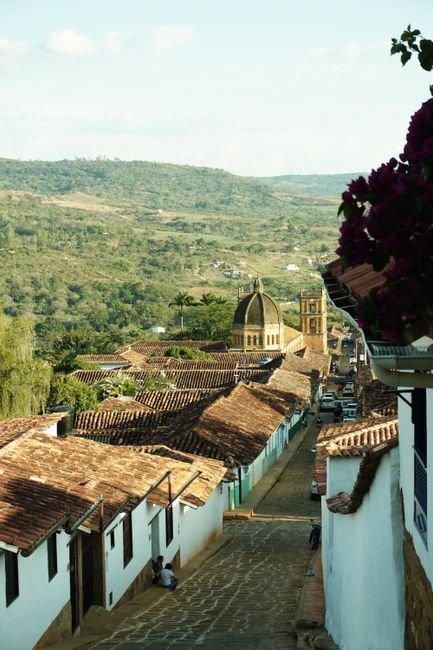
Barichara is a town of approximately 9,000 people at 1,300m above sea level in the Santander highlands. It was founded in 1702 after a miraculous image of the Virgin was found in a cave on the canyon slope - a colonial founding story that shaped the town’s subsequent architecture, which concentrated on churches, convents, and civic buildings around a central plaza. The streets are built from local limestone cut into rough rectangular blocks and the entire visible fabric of the town has been protected since its National Monument designation.
The main thing to understand about Barichara is that the experience of the place is the primary activity. There are specific things to do - the Camino Real trail, the churches, the artisan workshops, the viewpoints - but the pleasure is largely architectural and atmospheric rather than attraction-based. This is somewhere to walk slowly rather than tick off a checklist.
The Camino Real to Guane
The Camino Real (Royal Road) was the trade route connecting Barichara to the Chicamocha river valley, built on a path the Guane people used for centuries before the Spanish formalised it. The current stone path was constructed by convict labour in the late colonial period and has been in use since. It is 11km long, descends from Barichara to the village of Guane (population approximately 500), and is the single best walk in the Santander department.
The trail starts at the edge of Barichara near Calle 7 - a small sign marks the trailhead. The first 3km are through dry tropical scrub with cactus and sparse trees, with views opening toward the Chicamocha canyon. The middle section passes through denser vegetation in a ravine. The final kilometre approaches Guane across flat ground with views of the village against the canyon backdrop. Browse Barichara and Santander tours on GetYourGuide for guided hikes and colonial town walks with online booking.
Guane at the far end is a functioning village rather than a tourist site - a plaza, a church, the Museo Paleontológico y Arqueológico de Guane (open Tuesday to Sunday, entry approximately COP 5,000) which holds Guane mummies, fossils, and colonial artefacts, and a handful of small restaurants serving simple lunches for approximately COP 15,000 to 20,000.
Return from Guane: Mototaxis run from Guane back to Barichara for approximately COP 10,000 to 15,000 per person. Alternatively, walk back on the same trail (allow 3.5 hours for the uphill return) or take the jeep track road (longer, less scenic).
Logistics: Start no later than 8am. Carry 2 litres of water minimum. The trail is exposed between 10am and 3pm and the temperature can reach 33–36°C in the dry season. Wear proper walking shoes - the stone surface is uneven. No entrance fee; no guide required.
The Colonial Churches
Barichara has three colonial-era churches for a town of 9,000 people, which reflects its importance as a Santander colonial centre. Each has distinct character.
Catedral de la Inmaculada Concepción (1833, rebuilt after earlier construction): The main cathedral on the central plaza is the dominant architectural feature of Barichara. The facade of rough-cut ochre limestone with a twin-tower profile is the standard image of the town. The interior is single-nave with plain whitewashed walls - austere in the Santander style, focused on the main altar. Free entry; open daily 7am to 7pm.
Capilla de Santa Bárbara (1726): Built before the main cathedral, the Santa Bárbara chapel on the western edge of town is one of the oldest structures in Barichara. The scaled-down proportions and the local limestone construction feel more intimate than the cathedral. The adjacent cemetery - with tombs carved from the same limestone - is visually striking and historically significant. Free entry.
Capilla de Jesús Resucitado (Chapel of the Resurrected Jesus): A small chapel at the southern edge of the colonial grid with a single nave and a particularly well-preserved colonial interior. Used for daily mass at 7am.
Fundación Lemniscata (Paper Workshop)
The Fundación Lemniscata on Calle 6 is an artisan paper-making workshop using fique fibre from locally grown century plants - a technique with roots in both pre-Columbian and colonial-era production. The workshop produces handmade papers, books, cards, and art papers sold through its own shop.
Visits to the workshop are encouraged - the paper-making process is demonstrated, including fibre preparation, pulping, sheet formation, and pressing. Workshops for visitors cost approximately COP 30,000 to 50,000 and include making a small sheet to take away. The papers produced are among the most distinctive artisan products in Santander. Open Monday to Saturday 9am to 5pm.
Artisan Quarter and Stone Carving
Barichara’s artisan tradition extends beyond the paper workshop. Several carvers work the local ochre limestone into decorative and functional objects - small sculptures, architectural details, and ornamental pieces. Workshops can be found on Carrera 7 and Calle 5, some of which accept visitors who want to see the carving process.
Fique basketry and weaving - the Guane fibre craft tradition - is sold in several shops on the main plaza and on Carrera 7. Prices range from COP 15,000 for small baskets to COP 80,000 to 150,000 for large woven bags with traditional Guane geometric patterns.
Mirador del Cañón (Canyon Viewpoint)
A concrete mirador at the western edge of town gives an unobstructed view down into the Chicamocha canyon - the same canyon system visible from Bucaramanga, but from a completely different angle at 1,300m above the canyon floor. The best light is in the late afternoon (4–6pm) when the ochre canyon walls turn amber. The viewpoint is free, accessible on foot from the plaza in approximately 20 minutes.
The Plaza Principal and Town Walks
The main plaza (Plaza Santander) is the most compact and intimate of the colonial towns in this part of Santander - smaller than Villa de Leyva’s vast cobblestones, more personal. The surrounding streets are the core experience of Barichara: walk Calle 6 from the plaza to the Santa Bárbara chapel, then south on Carrera 7 to the canyon mirador, then back along Calle 5 past the artisan workshops. This 4km circuit covers the essential character of the town.
Photography note: The most photographed views are from the streets below the cathedral looking up toward the tower, and from the mirador looking back at the town against the canyon. The best light for both is in the morning before 10am.
Casa Museo Aquileo Parra
Barichara is the birthplace of Aquileo Parra, president of Colombia from 1876 to 1878. His birth house on Calle 5 has been converted to a small museum of 19th-century Barichara life - furnishings, photographs, and local historical documents. Entry approximately COP 5,000. Open Tuesday to Sunday 9am to 12pm and 2pm to 5pm.
Practical Notes
How much time to allow: Two nights and two full days is the ideal amount of time. Day one: walk the Camino Real to Guane and return. Day two: explore the town on foot, visit the artisan workshops, walk to the mirador, and spend the evening in the plaza. One night gives a rushed experience - Barichara is a place for slow attention.
The town is small: Everything listed above is within 1km of the main plaza. No transport is needed within the town.
Weekend visitors from Bogotá and Bucaramanga: Saturday afternoon and Sunday morning are the busiest periods. Arriving Thursday or Friday and leaving Sunday morning gives access to the town at its quietest.
Search hotels in Barichara on Booking.com
Dry season: Barichara’s Chicamocha-facing position gives it a semi-arid microclimate. The dry season (December to March) has the clearest skies and most pleasant walking conditions. The Camino Real becomes significantly hotter in March and April before the rains come.
More on Barichara: day trips from Barichara, where to stay in Barichara and Barichara travel guide.